

A visa denial is not always the end of the road. Many refusals can be answered with missing documents, a waiver, a new application built on changed circumstances, or a timely appeal or motion. The right step depends on the exact reason on your notice and on who denied you. An immigration lawyer reads that reason, tells you which path is open, and keeps you from filing a second application that fails for the same cause. At Nichols Law Offices, PLLC, you work directly with attorney Craig Nichols, who has nearly 30 years of experience serving families across Central New York, in English or Spanish.
Key Takeaways
- The denial notice names the legal section behind the refusal. That section decides whether you can send more evidence, reapply, request a waiver, or appeal.
- A consulate denial and a USCIS denial follow different rules. A USCIS denial usually has a 30-day clock for an appeal or motion (33 days if the decision was mailed).
- Visa records held by the State Department are confidential. Attorneys representing applicants are among the few people who can receive information about a case.
- A new application filed without fixing the cause of the first refusal often fails again, and a fraud finding can be permanent.
- Bring the denial notice, your receipts, and every document you submitted to your first consultation. They let a lawyer give you a real answer.
Table of Contents
- First, Find Out Who Denied You and Why
- What Each Type of Refusal Means for Your Next Step
- If USCIS Denied Your Case
- How an Immigration Lawyer Helps After a Denial
- Special Situations We See in Central New York
- What It Costs, and What Affects the Total
- Planning a Reapplication After Waiting
- When to Call a Lawyer
- Our Perspective
- Talk to Nichols Law Offices About Your Denial
- FAQ
- Sources
First, Find Out Who Denied You and Why
The first question is who made the decision. A U.S. consular officer abroad decides most visa applications. USCIS, inside the United States, decides petitions and applications such as a family petition, a fiancé(e) petition or a green card application. The two systems have different options and deadlines, so mixing them up costs time.
The second question is why. A refusal letter cites a section of the Immigration and Nationality Act (INA), the main federal immigration statute. The State Department’s Visa Denials page lists the grounds you will see most often:
| Section on your notice | What it generally means | What usually follows |
|---|---|---|
| 221(g) | The application is incomplete, or documents or administrative processing are missing | You supply what is requested; the case can continue |
| 214(b) | You did not show you qualify for the visa category, or did not overcome the presumption of immigrant intent | No appeal; reapply when circumstances have changed |
| 212(a)(2) | Certain criminal grounds, including crimes involving moral turpitude and drug violations | Possible waiver, depending on the facts |
| 212(a)(4) | Public charge, meaning concern that you would rely on public benefits | Stronger financial evidence or a new filing |
| 212(a)(6)©(i) | Fraud or material misrepresentation | Serious; usually requires a waiver |
| 212(a)(9)(B)(i) | Unlawful presence in the United States | Waiver may be available, depending on who your qualifying relative is |
The U.S. Embassy in Canada explains in its guidance on visa denials that the letter states the section of law and the options available. For a 221(g) refusal it identifies the additional information required and gives you one year to submit it.
When you read your notice, write down five things: the agency, the visa category, the legal ground or missing item, the response instructions, and any deadline. If any of these is unclear, that is the point to stop and get legal advice, before you send anything back.
What Each Type of Refusal Means for Your Next Step
221(g): The case is paused, not closed
A 221(g) refusal means the officer needs something more. Under the State Department’s Foreign Affairs Manual, 9 FAM 306.2, the refusal is overcome when you present the additional evidence or administrative processing finishes. For immigrant visa cases, you have one year from the refusal to produce the evidence. After that, you need a new DS-260 (the online immigrant visa application) and a new fee.
The common mistake is sending a partial response. Officers ask for specific items, and a lawyer can check that what you send answers the request exactly, in the right format, before the clock matters.
214(b): Reapply, but with something new
A 214(b) refusal applies only to that application, and the State Department says there is no appeal process for it. The same 9 FAM section explains that most 214(b) refusals are not overcome. Instead, the officer may suggest you reapply when the relevant circumstances have changed.
That means a second application with the same facts and the same documents is likely to get the same answer. What counts as a change depends on your situation, such as new employment, family or financial ties, or a clearer travel purpose. A lawyer helps you decide whether those changes are real and well documented before you pay another fee.
212(a) grounds: Evidence or a waiver
A refusal under 212(a) is an inadmissibility ground. The Foreign Affairs Manual says you can overcome it by presenting sufficient evidence that the ineligibility no longer applies. If it still applies, the consular officer may tell you that you can apply for a waiver of ineligibility, which the Department of Homeland Security decides. USAGov confirms that you have the right to ask why you were denied and whether you are eligible for a waiver.
For an applicant abroad who is inadmissible for an immigrant or K/V visa, the waiver is usually filed with USCIS on Form I-601. A USCIS filing chart explains that Form I-212, permission to reapply after removal, may also be needed, and that a denied waiver can be appealed or reopened on Form I-290B. Waivers usually depend on proving hardship to a qualifying relative, a U.S. citizen or permanent resident spouse or parent. That evidence needs careful preparation, because the waiver is discretionary, meaning the decision weighs your whole story and not a checklist.
Our office handles rehabilitation applications and waivers, including for families whose case stalled because of an old arrest, a past immigration violation, or time spent in the country without status.
If USCIS Denied Your Case
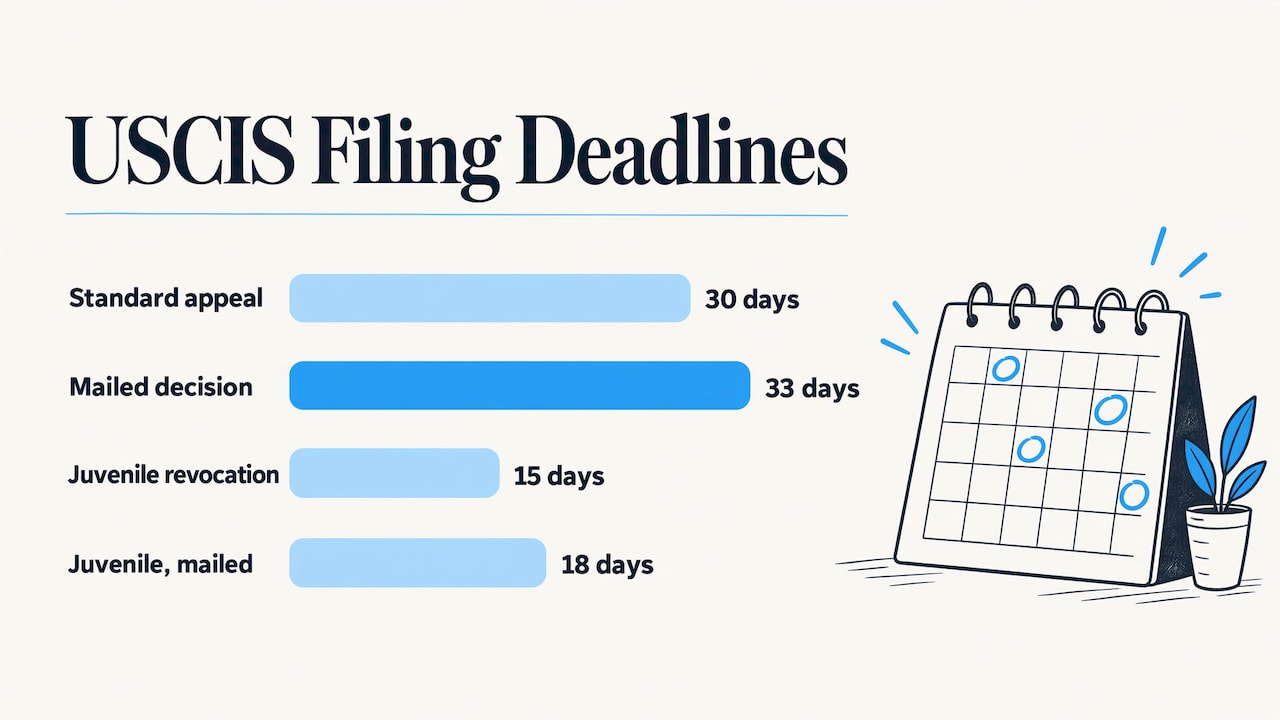
A USCIS denial works differently. According to the USCIS Policy Manual, you file Form I-290B to appeal to the Administrative Appeals Office or to ask USCIS to reconsider or reopen the decision. The deadline is 30 days from the decision, or 33 days if it was sent by mail. For the revocation of an approved Special Immigrant Juvenile petition the window is shorter: 15 days, or 18 by mail.
The federal regulation at 8 CFR 103.3 adds that an untimely appeal is rejected without a refund, though it may be treated as a motion if it meets the motion requirements. Do not count on that exception. It is far safer to treat the 30 days as a hard line.
An appeal and a motion are not the same thing. An appeal argues that the decision was wrong based on the record. A motion to reopen presents new facts. A motion to reconsider argues the decision misapplied law or policy. Choosing the wrong one, or filing without a legal argument, wastes your filing fee and your window.
If you are already in the United States and applying for a green card, the denial may also raise questions about your status. A denied adjustment of status application can leave a person without lawful status, and in some cases lead to removal proceedings. If your notice is a denial and not just a request for evidence, ask a lawyer about it right away. Our removal defense guide explains what to expect if a case goes to immigration court.
How an Immigration Lawyer Helps After a Denial
A lawyer is not a guarantee of approval, and no honest one promises that. What a lawyer adds is judgment and access.
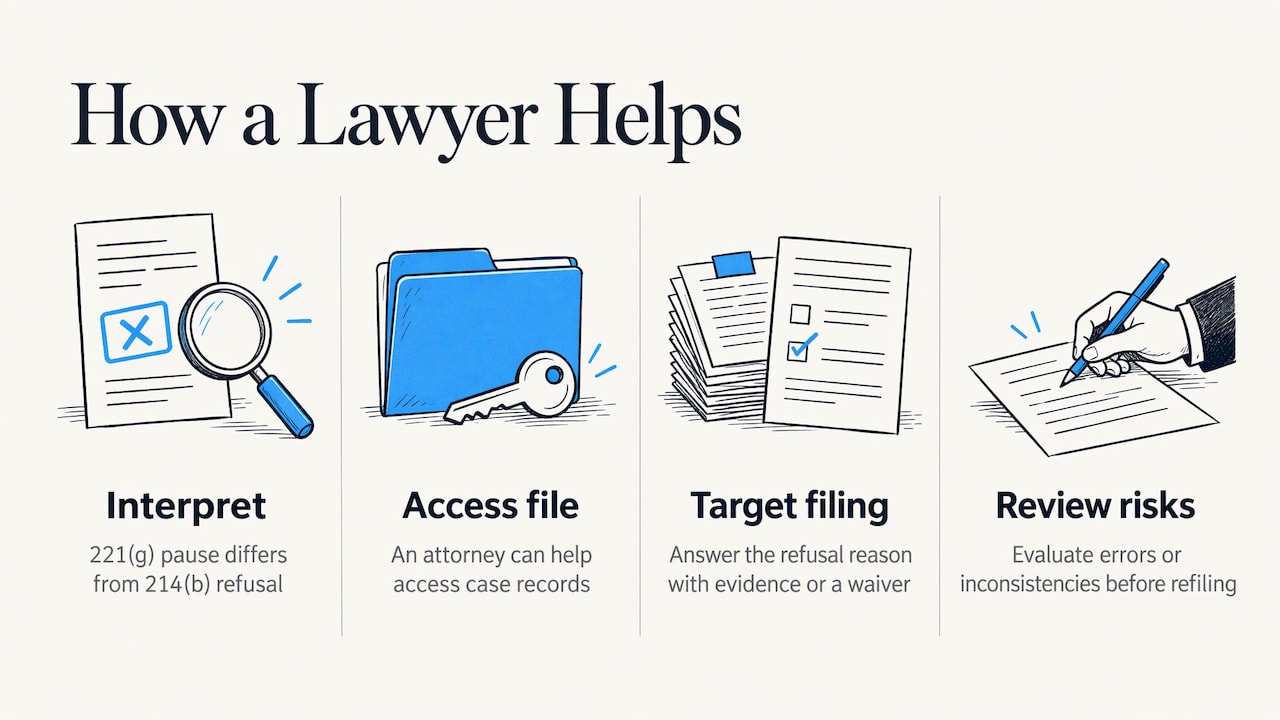
Reading the refusal correctly. Many applicants cannot tell a temporary 221(g) pause from a 214(b) refusal, or a fraud finding from a missing document. The difference decides whether you wait, reapply, file a waiver or appeal.
Access to the file. The State Department states that visa case records are confidential under INA section 222(f). Information can be provided to visa applicants, with exceptions that include U.S. sponsors, attorneys representing visa applicants, members of Congress, and others acting with the applicant’s permission. If you want to understand what the consulate actually recorded, having an attorney appointed to represent you can open that door.
Fixing the cause, not just refiling. A strong second filing answers the exact reason for the first refusal. That might mean new financial evidence, a corrected prior statement, hardship documentation, or a waiver submitted before the reapplication.
Protecting you from permanent problems. Fraud and misrepresentation findings can carry long-lasting consequences. If a past form contained an error, an old statement was inconsistent, or a document turned out to be wrong, you want an attorney to evaluate it before you file again.
Keeping the family case coordinated. Many denials involve a spouse, parent or child already in the United States. Our work in family immigration, immigrant visas and consular processing means the petition, the interview and any waiver can be planned together instead of treated as separate problems.
Special Situations We See in Central New York
Military families. Families of service members, including those connected to Fort Drum, sometimes face denials tied to how a spouse or parent entered the country or stayed. Parole in Place can open a route to a green card for some military family members, and we explain it in our guide on Parole in Place for military families.
Fiancé(e) visa denials. A K-1 refusal often comes down to proof that the relationship is genuine and that the couple met in person within the required period. If yours was refused, our page on fiancé visa cases explains how the process works.
Families with an older immigration problem. Unlawful presence, a prior removal order or an old conviction can trigger a refusal years after the event. These cases usually turn on a waiver, so the strength of the hardship evidence matters more than the speed of the filing.
Applicants affected by newer procedures. Visa procedures have tightened in recent years. A June 2025 State Department announcement, described by the University of Connecticut’s global affairs office, requires F, M and J applicants to set social media accounts to public and routes eligible F and J applicants through administrative processing for online-presence review. If you received a 221(g) after an interview, ask what is outstanding and answer it completely. Rules like these change, so confirm the current requirements on the State Department’s site before you act.
What It Costs, and What Affects the Total
Legal fees vary by case, and we do not publish a price list. What changes the total is how complicated the denial is: a missing-document response is a smaller task than a waiver with hardship evidence or an appeal with a legal brief. The best way to get a real figure is a consultation after the lawyer has reviewed your notice.
Government fees are separate and set by the agencies. For example, a DOJ Executive Office for Immigration Review policy memorandum effective July 9, 2025, implementing the One Big Beautiful Bill Act, set the Form I-601 waiver fee at $1,050. It also says these fees are subject to annual inflation adjustment beginning in fiscal year 2026. Check the official fee schedule for the amount in force when you file, since fees change on a schedule.
For the State Department, a new application after a refusal generally means paying the visa application fee again, except for 221(g) refusals. That is one more reason to resolve the cause of the denial before you reapply and not after a second refusal.
Planning a Reapplication After Waiting
If you decide to reapply, use the waiting period to build the record that the first application lacked. Gather updated employment letters, property or lease documents, tax records, family documents and proof of your travel history. Keep copies of everything the consulate or USCIS sent you.
Financial planning is part of that picture for many families, from sponsor income to long-term goals like buying a home. If housing is part of your long-term plan, this overview of mortgage questions for noncitizens shows what lenders ask about status. Always make sure any financial statement you give an immigration officer is accurate and consistent with your earlier filings.
Never submit altered or unverifiable documents to make a second attempt look stronger. A finding of fraud or willful misrepresentation can create a much bigger problem than the original denial.
When to Call a Lawyer
Contact an attorney quickly if any of the following applies:
- Your notice cites a 212(a) ground, especially fraud, criminal history or unlawful presence.
- USCIS denied your petition or application and the 30-day window is running.
- You were refused under 214(b) and do not know what has to change.
- You have a removal order, a pending court date or a notice to appear.
- You received a request for evidence you do not fully understand.
If you have a court date or a notice from immigration authorities, do not wait for a convenient time to ask for advice.
Our Perspective
In nearly 30 years of practice in Central New York, I have learned that a denial feels final to families long before it actually is. The notice arrives in dense legal language, and people assume the door has closed. Often it has only changed shape.
What matters most is that someone reads the notice with you, line by line, and tells you plainly what it means. At our firm, you speak with me directly, in English or Spanish, so your questions are answered by the attorney responsible for your case.
Our approach is to find the real reason behind the refusal, decide whether the path forward is more evidence, a waiver, an appeal, a motion or a stronger new application, and then prepare it carefully. Families we serve in Syracuse, Utica, Rome, Binghamton and around Fort Drum deserve a plan, not a guess.
Craig Nichols
Talk to Nichols Law Offices About Your Denial
If you or a family member received a visa denial, Nichols Law Offices, PLLC can review your notice and explain your options. We assist with green cards, family-based visas, adjustment of status, waivers, and removal defense, with bilingual support and knowledge of how immigration matters are handled across Central New York.
Start by bringing your denial notice and your filing receipts, then contact us through our main page to arrange a consultation. You can also read about our green card and adjustment of status services before you call.
FAQ
Can an immigration lawyer help after a U.S. visa denial?
Yes. A lawyer can read the legal ground on the notice, explain whether you can submit evidence, reapply, request a waiver, or appeal, and prepare the filing. Because State Department visa records are confidential, an attorney representing you is also one of the parties who can receive information about your case.
Can I appeal a visa denial from a U.S. consulate?
Usually not. The State Department says a 214(b) refusal has no appeal process, and the usual route is a new application showing changed circumstances. Some refusals can be overcome with additional evidence, and some inadmissibility grounds can be addressed through a waiver. A denial from USCIS is different, and may be appealed or reopened on Form I-290B within 30 days.
How long should I wait before reapplying?
There is no single waiting period. For a 221(g) refusal in an immigrant visa case, you have one year to provide the requested evidence, and after that you need a new application and fee. For a 214(b) refusal, the point is to reapply when something relevant has genuinely changed, not when a set time has passed.
Is it worth hiring a lawyer for a visa denial?
It usually is when the notice cites an inadmissibility ground, when a USCIS deadline is running, or when a second refusal would be costly for your family. A lawyer helps make sure the next filing answers the actual reason for the denial. We can review your situation and tell you what the next step looks like.
Sources
- Visa Denials, U.S. Department of State
- Visa Denial, U.S. Embassy and Consulates in Canada
- 9 FAM 306.2, Overcoming a Refusal
- What happens if your visa application is rejected, USAGov
- USCIS filing chart for waivers of inadmissibility
- USCIS Policy Manual, Volume 6, Part J, Chapter 5
- 8 CFR 103.3, Denials, appeals, and precedent decisions
- Update on Pause in Visa Processing and Social Media Vetting, University of Connecticut
- EOIR Policy Memorandum 25-35, Statutory Fees Under the One Big Beautiful Bill Act