A VAWA immigration lawyer helps you prove, in writing and with evidence, that you qualify to file your own petition for immigration status without your abuser’s cooperation. The lawyer interviews you, builds your account of what happened, gathers documents, files the petition with USCIS and stays with you through requests for evidence and the green card stage. At Nichols Law Offices, PLLC, our Syracuse office offers direct, one-on-one guidance from attorney Craig Nichols, with bilingual support in English and Spanish, so you can talk through a painful history with someone you come to trust.
Key Takeaways
- VAWA lets certain abused spouses, children and parents of U.S. citizens or lawful permanent residents file a self-petition on Form I-360, without the abuser’s help.
- You must show a qualifying relationship, battery or extreme cruelty, shared residence, good moral character and, for spouses, a good-faith marriage.
- Your own detailed affidavit is one of the most important parts of the petition, and a lawyer helps you write it carefully.
- An approved petition can open the way to work authorization and, in many cases, a green card.
- Confidentiality rules and safe-address procedures exist to protect you during the process.
Table of Contents
- What VAWA Offers Immigrant Survivors
- Who Can File a VAWA Self-Petition
- How a VAWA Immigration Lawyer Helps
- Your Affidavit: The Heart of the Petition
- What Evidence Supports a VAWA Case
- Filing Without the Abuser Knowing
- Confidentiality and Safe Addresses
- What Happens After You File
- When You Should Speak With a Lawyer
- Our Perspective
- Work With Nichols Law Offices in Central New York
- FAQ
- Sources
What VAWA Offers Immigrant Survivors
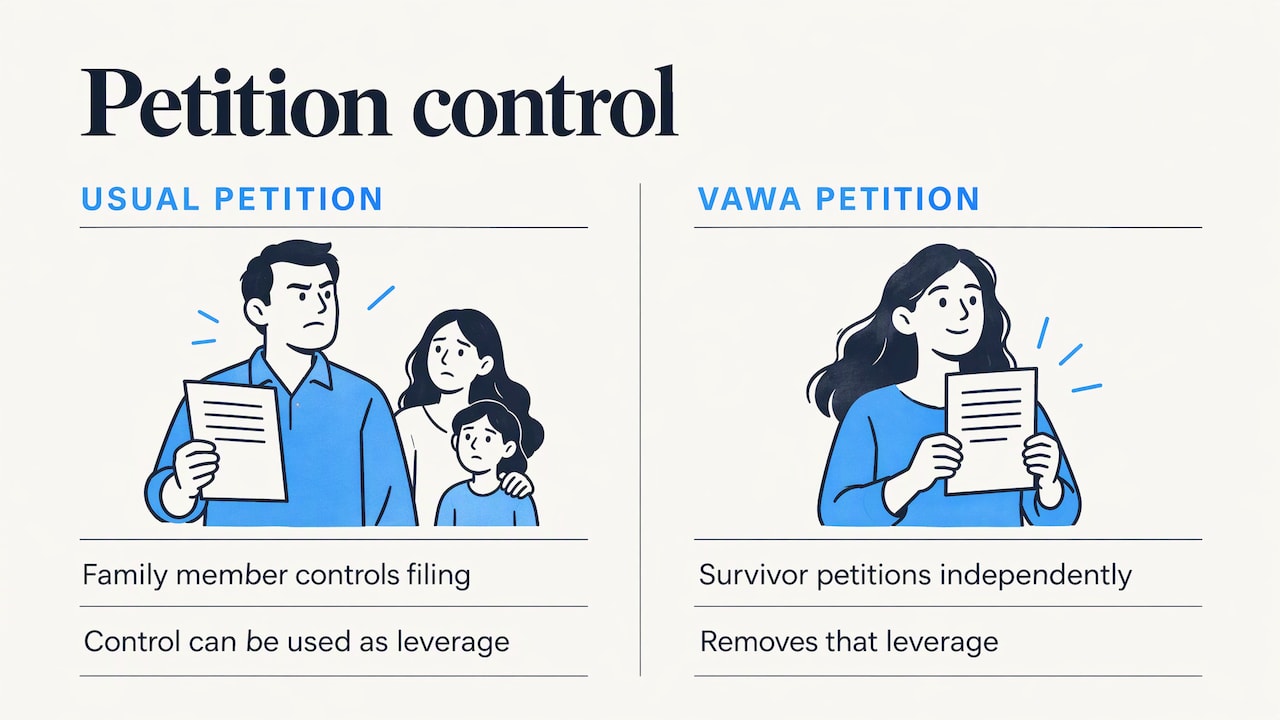
The Violence Against Women Act created a pathway for people who are abused by a family member who holds U.S. citizenship or a green card. Normally, that family member would control the immigration petition. Abusers sometimes use that control as a weapon, threatening to withdraw support or to report you. VAWA removes that leverage by allowing you to petition on your own.
Despite the name, VAWA is not limited to women. Men and women, adults and children, can qualify. If you are in danger right now, call 911. The National Domestic Violence Hotline offers free, confidential support at 1-800-799-7233 at any hour.
Who Can File a VAWA Self-Petition
USCIS says qualifying applicants include:
- Abused spouses or former spouses of U.S. citizens or lawful permanent residents
- Abused children of a U.S. citizen or lawful permanent resident
- Abused parents of a U.S. citizen who is 21 or older
A child self-petitioner generally must be under 21 and unmarried. USCIS also says a person aged 21 to 25 may qualify when abuse was the main reason the filing was delayed.
The core requirements
USCIS explains that a self-petitioner must prove eligibility by a preponderance of the evidence, meaning it is more likely than not that each requirement is met. The main elements are:
- A qualifying relationship to the citizen or permanent resident.
- Battery or extreme cruelty during the relationship.
- Shared residence with the abuser at some point.
- Good moral character.
- A good-faith marriage, if you are filing as a spouse.
Abuse is not only physical. Extreme cruelty can include threats, isolation, financial control and other coercive behavior. That is why the way your story is told matters so much.
How a VAWA Immigration Lawyer Helps
Many survivors ask whether they truly need an attorney. You may file without one, but a petition is judged on detail and credibility, and a lawyer’s work is largely about presenting your situation completely. According to a pro bono overview from the National Immigrant Justice Center, the lawyer’s role typically includes:
- Interviewing the client
- Preparing the client’s affidavit
- Gathering supporting documents
- Preparing the forms and filing them with a cover letter
- Responding to requests for evidence or notices of intent to deny
- Later advising on employment authorization, filing adjustment applications and representing the client at an interview
Screening your whole immigration history
The same overview says a lawyer should screen for removal proceedings, prior applications, entries and exits, arrests or convictions, prior marriages and divorce dates before filing. These facts can affect eligibility, inadmissibility and strategy, and they may point to other relief that fits you better. For example, some survivors of crime may be better suited to a U visa for victims of crime, and a careful review tells you which path to take.
Handling difficult evidence
Some survivors have no documents because the abuser held, hid or destroyed them. Nolo’s legal encyclopedia notes that a VAWA lawyer can help obtain evidence and develop witness declarations in that situation. It also notes that counsel can matter when a criminal record or a past immigration-fraud finding complicates a case, because a lawyer may identify exceptions or challenge an erroneous finding.
Your Affidavit: The Heart of the Petition
The National Immigrant Justice Center’s pro bono manual describes the detailed affidavit as one of the most important components of the petition. It also says developing a complete account of abuse takes sufficient time and trust.
That matches what we see as a principle of good practice: no one should be rushed through the worst moments of their life. A good interview moves at your pace, in your language, and turns your memories into a clear, organized and truthful account that an adjudicator can follow.
What Evidence Supports a VAWA Case
USCIS considers any credible evidence and decides its credibility and weight. It requires proof of the family relationship and of the abuser’s citizenship or permanent resident status. Beyond that, a legal-aid checklist from Tahirih Justice Center lists possible evidence such as:
- Personal and witness affidavits
- Police or court records and protective orders
- Medical or counseling records
- Shelter records
- Photographs
- School records
- Leases, bills, correspondence and tax records showing shared life
- Proof of the abuser’s status
That checklist names Form I-360, Form G-28 (the attorney’s notice of appearance), a detailed cover letter or evidence index and your declaration as core filing materials. The Delaware Domestic Violence Coordinating Council’s advocate guide groups key evidence into proof of abuse, identity, the spouse’s status, the marriage, U.S. residence, shared residence and the end of any prior marriages.
You do not need every document
A missing police report does not end a case. Because USCIS weighs any credible evidence, a well-organized combination of declarations, records and photographs can carry real weight. When evidence is thin or unclear, USCIS may issue a Request for Evidence or a Notice of Intent to Deny, which is why the first filing should be as complete as your circumstances allow.
Filing Without the Abuser Knowing
One of the most important features of VAWA is independence. Nolo’s guidance says the self-petitioner files on their own and does not need to notify the abuser. Your lawyer should still talk with you about safety planning around mail, phones and shared devices before anything is sent, because your day-to-day safety matters as much as the paperwork.
Confidentiality and Safe Addresses
Federal law protects VAWA applicants. USCIS applies confidentiality protections under 8 U.S.C. §1367 and has safe-address procedures for protected individuals. Under USCIS’s safe-address policy, these rules restrict disclosure of information about protected persons and prohibit adverse decisions based solely on information from prohibited sources, with limited exceptions.
The same policy says officers review each form individually and consider the address chosen through Form G-28 when deciding where to send notices and identity documents. In practice, this means an attorney’s office can often serve as a safer place for mail. We discuss this with you early so notices do not reach the wrong hands.
What Happens After You File
If USCIS approves the I-360, you may seek permanent residence through adjustment of status inside the United States or through consular processing abroad. USCIS notes an approved I-360 gives immigrant classification, not immigration status. It may consider deferred action case by case, and approved petitioners are eligible to apply for work authorization.
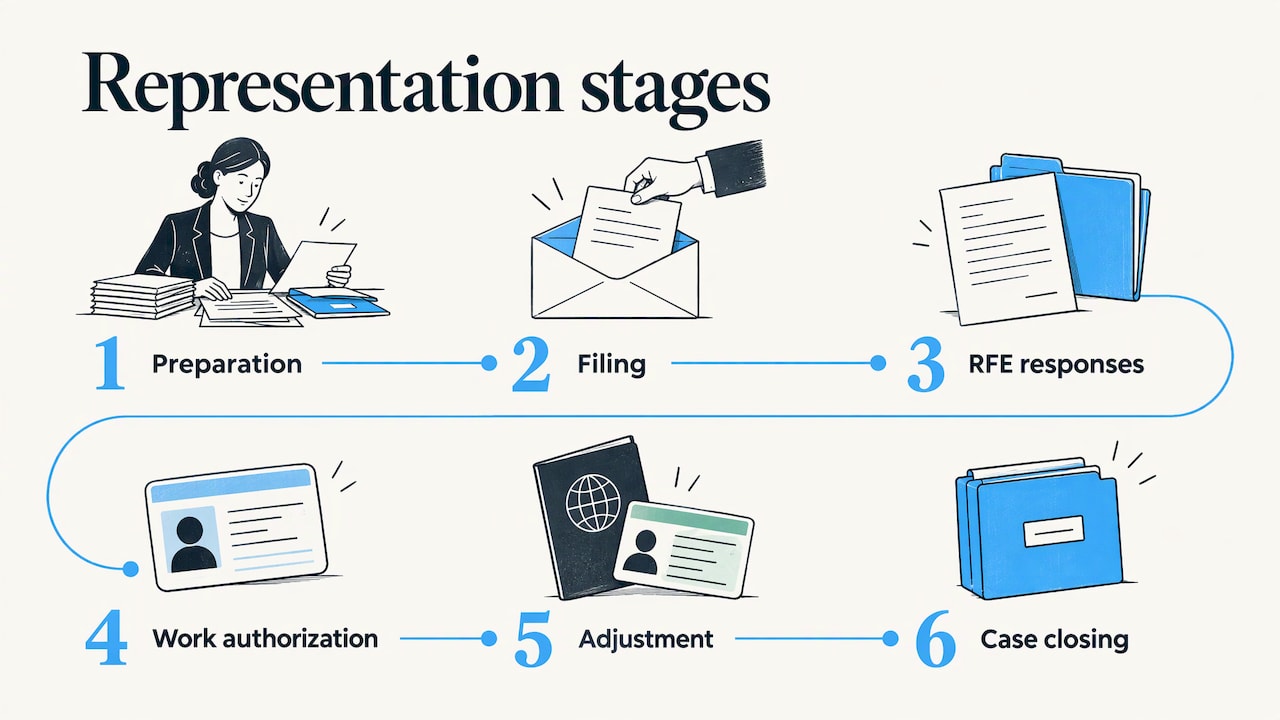
USCIS training materials describe the possible benefits the same way: deferred action, an employment authorization document and the chance to seek lawful permanent residence. Her Justice’s 2025 manual describes representation as continuing through preparation, filing, RFE responses, work authorization, adjustment and case closing. The green card stage is a milestone in its own right, and we explain how it works on our page about adjustment of status.
When You Should Speak With a Lawyer
Consider calling a lawyer before filing if any of these apply:
- You have been in removal proceedings or have a prior deportation order
- You have been arrested or convicted of anything, even long ago
- You were married before, or your divorce dates are unclear
- You have no documents because the abuser kept them
- You are unsure whether your marriage or your abuser’s status qualifies
- You have children who may need to be included
If you are facing court, our deportation defense work and VAWA work can be coordinated, since timing and strategy affect each other.
Our Perspective
Survivors rarely come to us ready to tell everything at once. They come after years of being told that their status belongs to someone else, and that without that person they have nowhere to turn. Our first job is to show that this is not true.
With nearly 30 years of practice in Central New York, we have learned that a strong case begins with trust. You speak with me directly, not a rotating cast of staff, and we can work in English or Spanish so that you never have to translate your hardest memories.
We think of a VAWA petition as a lifeline and a pathway: a way out of dependence on someone who hurt you and toward a future you control. We take the time to listen, to look at your full immigration history, and to build a petition that tells your story clearly and honestly.
Craig Nichols
Work With Nichols Law Offices in Central New York
Nichols Law Offices, PLLC represents individuals and families across Syracuse, Rome, Utica, Binghamton, Fort Drum, Onondaga County and Jefferson County. Our work includes green cards and adjustment of status, family immigration, asylum, humanitarian relief and U visas, so we can look at every option open to you rather than only one.
If you want to talk about a VAWA self-petition, contact our Syracuse office. Tell us what is safe for us to use when we reach you, and we will arrange the conversation around that.
FAQ
Can I file a VAWA petition if I am still living with my abuser?
Yes, living together does not by itself bar a petition, and you must show you shared a residence at some point. Because safety is the priority, talk with a lawyer or a domestic violence advocate about planning before you file. If you are in immediate danger, call 911.
Do I need a police report to qualify?
No single document is required. USCIS considers any credible evidence, so affidavits, medical or counseling records, photographs and other proof can together support the abuse claim. A lawyer helps decide which combination is strongest in your situation.
Will my abuser be told about my petition?
The self-petitioner files independently and does not need to notify the abuser. USCIS also applies confidentiality protections under 8 U.S.C. §1367 and safe-address procedures. Ask your attorney to set up a safe mailing address through Form G-28.
What can I get if my VAWA petition is approved?
An approved I-360 gives immigrant classification. You may then apply for work authorization, USCIS may consider deferred action case by case, and you may seek a green card through adjustment of status or consular processing.
Who can file a VAWA petition besides a wife?
Husbands and former spouses of U.S. citizens or permanent residents can qualify, as can abused children and abused parents of U.S. citizens aged 21 or older. Each category has its own proof requirements, which a lawyer can walk you through.
Sources
- Abused Spouses, Children and Parents | USCIS
- Chapter 2 – Eligibility Requirements and Evidence | USCIS Policy Manual
- National Engagement: VAWA I-360 Self-Petition, T Visa and U Visa | USCIS
- USCIS Updates Customer Service and Safe Address Procedures
- Safe Address and Special Procedures for Persons Protected Under 8 U.S.C. 1367 | USCIS
- Overview of Pro Bono Representation in a VAWA Self Petition | National Immigrant Justice Center
- VAWA Pro Bono Attorney Manual | National Immigrant Justice Center
- VAWA Manual 2025 | Her Justice
- VAWA Application Document Checklist | Tahirih Justice Center
- Guide for Advocates Working with Immigrant Victims | Delaware DVCC
- Do I Need an Immigration Lawyer for Help Filing a VAWA Case? | Nolo
- The National Domestic Violence Hotline