

If you or someone you love has received a Notice to Appear, you need a removal defense attorney who knows immigration court and will stay with your case from the first hearing to the last. A lawyer can review the charges against you, identify the forms of relief you may qualify for, and prepare your evidence and testimony before the judge. At Nichols Law Offices, PLLC, our Syracuse attorney, Craig K. Nichols, brings nearly 30 years of experience to families across Central New York.
This guide explains what removal proceedings are, how the immigration court process unfolds, which deadlines matter, and how to choose someone you can trust.
Key Takeaways
- Removal proceedings begin when the Department of Homeland Security files a Notice to Appear with the immigration court. Receiving one is serious, but it is not a final decision.
- You have the right to be represented by a lawyer in immigration court, but at your own expense. Only authorized attorneys and accredited representatives can speak for you there, not notarios or visa consultants.
- Deadlines are short: 30 days to appeal a judge’s decision, and one year to file for asylum in most cases. Acting early protects your options.
- Relief from removal may include asylum, withholding of removal, Convention Against Torture protection, or cancellation of removal, depending on your facts.
- We offer one-on-one representation with direct communication from the attorney and support in English and Spanish.
Table of Contents
- What removal proceedings are and who can be placed in them
- What happens in immigration court, step by step
- Detained and non-detained cases: deadlines to know
- Defenses and forms of relief that may be available
- Why a removal defense attorney matters
- Choosing a representative you can trust
- After the judge decides
- Our perspective on removal defense
- Talk with our Syracuse office
- FAQ
- Sources
What removal proceedings are and who can be placed in them
Removal proceedings are the formal process the government uses to decide whether a person who is not a U.S. citizen should be required to leave the country. Formal removal proceedings are conducted before an immigration judge within the Executive Office for Immigration Review (EOIR), which is part of the Department of Justice. They start when the Department of Homeland Security (DHS) files a Notice to Appear with the immigration court, alleging that the person is subject to removal.
People in many different situations can be placed in proceedings. Some entered without inspection. Others came lawfully and later fell out of status, had an application denied, or faced allegations tied to a past criminal matter. Green card holders can be placed in proceedings too. The Notice to Appear is the charging document: it sets out the factual allegations and the legal charges of removability that DHS says apply to you.
Two points are worth remembering from the start:
- An allegation is not a finding. The judge decides whether DHS can prove the charges, and your attorney can challenge them.
- Being charged does not mean you have no options. Many people in proceedings have a path to stay, and finding that path is the core of removal defense.
What happens in immigration court, step by step
Immigration court feels unfamiliar to almost everyone who walks into it. Knowing the sequence makes it less frightening.
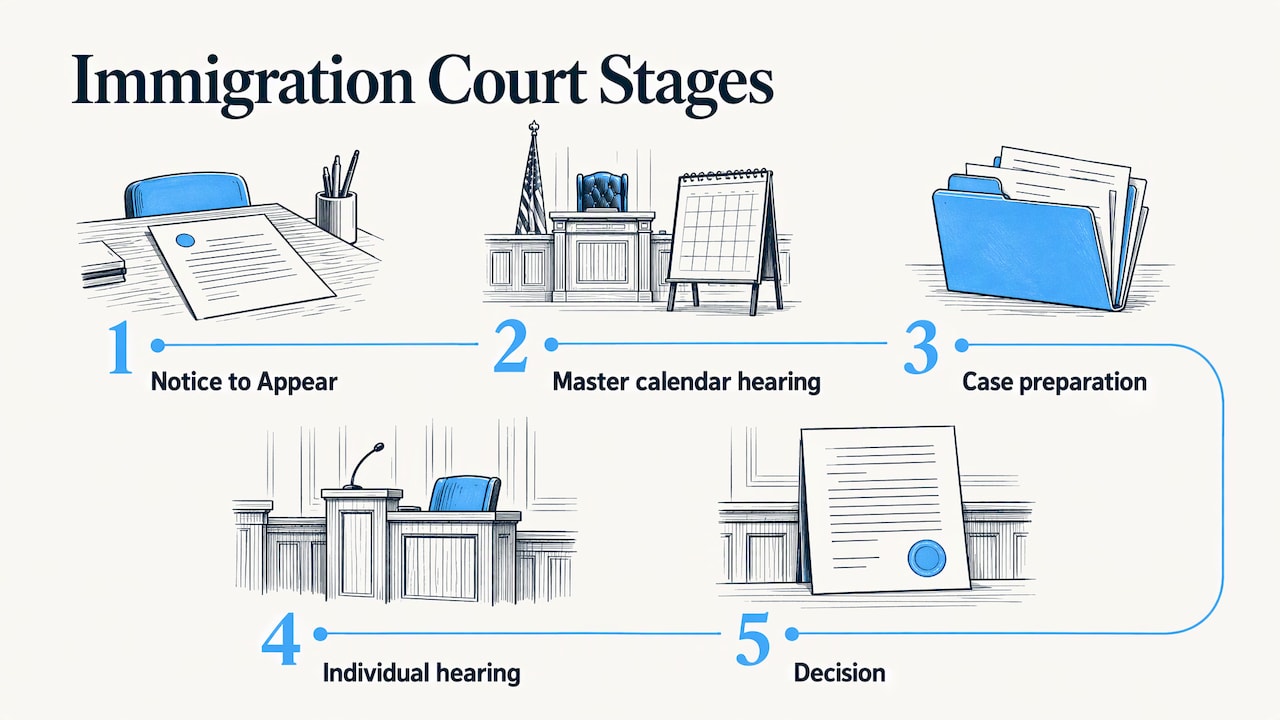
1. The Notice to Appear
The notice tells you the charges and instructs you to appear before an immigration judge. Read it carefully, keep the original, and make sure the court has your current mailing address. Missing a hearing can lead to an order of removal issued in your absence, so every notice you receive matters.
2. The master calendar hearing
The first hearing is usually a master calendar hearing. This is a preliminary session where the judge explains the respondent’s rights, identifies the issues, and schedules future hearings. It is often short, and several people may be scheduled the same morning. This is typically where your attorney responds to the charges and tells the court which forms of relief you will seek.
3. Preparing your case
Between hearings, the real work happens. Your attorney gathers records, identifies witnesses, prepares your declaration, and files applications. For many people, this stage decides how strong the case will be on the day of the merits hearing.
4. The individual hearing
The individual hearing, sometimes called the merits hearing, is the trial-like stage. The judge hears testimony, reviews evidence, and decides on applications for relief from removal. You may be asked to testify, and DHS may question you. Your attorney presents your evidence, calls witnesses, and argues why you qualify for relief.
5. The decision
At the end of the individual hearing, the judge typically issues an oral decision or reserves the right to issue a written decision later. Either side may be able to appeal, which is why the 30-day appeal deadline discussed below is so important.
Detained and non-detained cases: deadlines to know
Whether you are detained changes the pace. Detained cases generally move faster, and the court sets filing deadlines for people in detention. For people who are not detained, the EOIR Policy Manual gives general filing timelines.
| Stage | Typical filing timeline | Notes |
|---|---|---|
| Before a master calendar hearing | Due 15 days before the hearing if requesting a ruling | For detained people, the court sets the deadline |
| Before an individual hearing | Generally 30 days before the hearing for non-detained respondents | Evidence and witness lists are typically part of this filing |
| Appeal to the Board of Immigration Appeals | Form EOIR-26 must be received within 30 days of the judge’s decision | Late appeals are generally rejected |
| Motion to reconsider | 30 days | Applies to a final administrative order |
| Motion to reopen | Generally 90 days | Exceptions exist in limited circumstances |
The judge’s own scheduling order and the current EOIR Policy Manual control in your case, so confirm your exact dates with your attorney. Missing a filing deadline can cost you the chance to present key evidence, and that is one of the most common reasons people turn to counsel early.
Defenses and forms of relief that may be available
Removal defense usually works on two tracks: contesting whether the government can prove you are removable, and asking the judge for relief even if you are. Relief can include asylum, withholding of removal, protection under the Convention Against Torture, or cancellation of removal. Each has its own legal elements, and your evidence must address those elements specifically.
Here is how the main options differ in plain terms:
- Asylum: For people who fear persecution in their home country on protected grounds. A defensive asylum application must generally be filed within one year of arrival in the United States, subject to certain exceptions. If you are considering asylum, read about our asylum representation.
- Withholding of removal and Convention Against Torture protection: Protections for people who face serious harm if returned, with different legal standards from asylum.
- Cancellation of removal: A form of relief available to people who meet specific eligibility requirements. Whether you qualify depends on your status, your time in the country, your family ties, and your history.
- Adjustment of status and waivers: Some people in proceedings are eligible for a green card through a family member and may need a waiver to overcome a past issue. We handle adjustment of status and green card cases as well as rehabilitation applications and waivers.
- Other humanitarian options: Depending on the facts, protections such as U-visas for crime victims, or DACA for Dreamers, may be part of the conversation.
The right choice depends on your history, and some people qualify for more than one. A careful screening of your whole immigration and family history, before the first hearing if possible, is how a good attorney finds the strongest route.
What evidence supports an application
Evidence can include your own testimony, documents, and statements from witnesses. Practical examples include:
- Identity and civil records, such as birth and marriage certificates
- Proof of how long you have lived in the United States, such as leases, tax records, school and medical records
- Letters from family members, employers, clergy, and community members
- Police, court, or medical records relevant to your claim
- Country condition reports and expert statements, in protection cases
If any of your records are in another language, they will need a complete, accurate English translation to be usable. Our guide to qualified translators for USCIS documents explains who can prepare them, and the same care applies to papers you plan to put before an immigration judge.
Why a removal defense attorney matters
You have the right to counsel in these proceedings, but at your own expense. The government does not appoint a lawyer for you in the way a criminal court might. The Immigrant Legal Resource Center notes that legal representation is the single most important factor in whether a person wins or loses a removal case.
Here is what a removal defense attorney does in practice:
- Reviews your Notice to Appear and checks the charges against your records
- Screens you for every form of relief, including ones you may not know exist
- Appears with you at the master calendar hearing and handles the court’s questions
- Meets filing deadlines and organizes your evidence
- Prepares you to testify and presents your case at the individual hearing
- Advises you on appeal, reopening, and other next steps after a decision
Just as important, a good attorney explains what is happening in language you understand, so you are never guessing what the judge just said.
Choosing a representative you can trust
Before you hire anyone, confirm they are authorized to appear. Non-lawyer immigration specialists, visa consultants, and notarios are not authorized to represent people before an immigration court or the BIA. The Department of Justice also urges people to check the List of Disciplined Practitioners to make sure a representative is qualified. In many Spanish-speaking communities, the word notario suggests a legal professional, when in the United States it generally does not. If someone promises results, asks for payment for forms you could not verify, or tells you to avoid court, step back and speak with a licensed attorney.
A few practical questions can guide your choice:
- Is the person a licensed attorney, and will that attorney personally handle your case?
- Do they regularly practice in immigration court, not only on applications?
- Can they communicate with you, and your family, in your language?
- Will they explain fees and the scope of representation in writing?
- Are they familiar with the local area, including where hearings are held and how local offices work?
We built our practice around these points. Clients work directly with Craig Nichols, communicate in English or Spanish, and benefit from local knowledge of Syracuse and the surrounding region, including Rome, Utica, Binghamton, and Fort Drum. For a closer look at what we do locally, see our page on deportation defense in Syracuse.
After the judge decides
A decision is not always the end. If the judge grants relief, you may receive status or protection, and your attorney will explain the next steps, such as applying for work authorization or a green card where applicable. If the judge denies your case, you may have options, but the clocks start immediately.
- Appeal: Form EOIR-26 must reach the BIA within 30 days of the judge’s decision.
- Motion to reconsider: Generally due within 30 days of a final administrative order.
- Motion to reopen: Generally due within 90 days, with limited exceptions.
If you receive a decision, contact an attorney the same day. Do not wait to see what happens next, because a missed deadline can close doors that would otherwise stay open.
Our perspective on removal defense
Over nearly three decades in Central New York, we have seen how frightening a Notice to Appear is for a family. The fear is understandable, but we have also seen that a prepared, well-documented case can change the outcome.
We believe the most valuable thing we offer is attention. When you hire us, you work with the attorney who handles your case, not a rotating cast. You get direct answers, in English or Spanish, about where you stand, what the next hearing means, and what we need from you.
Removal defense is rarely about one dramatic moment in court. It is about the months of careful work before it: understanding your history, finding the right form of relief, collecting honest evidence, and preparing you to tell your story clearly. We take that responsibility seriously, because for our clients the stakes are home, family, and the future they are building.
If you are facing removal proceedings, reach out early. The sooner we can look at your documents, the more options we can help you explore.
Craig Nichols
Talk with our Syracuse office
Nichols Law Offices, PLLC represents individuals and families in deportation defense, asylum, adjustment of status, family immigration, waivers, and humanitarian relief. We serve Syracuse, Rome, Utica, Binghamton, Fort Drum, and communities across Onondaga and Jefferson counties, with bilingual support in English and Spanish.
If you have a Notice to Appear, a hearing date, or questions about your status, contact Nichols Law Offices so we can review your situation and talk through the road ahead.
FAQ
What is the difference between removal proceedings and deportation?
Removal is the current legal term for the process, and most people still call it deportation. It starts when DHS files a Notice to Appear and ends with an immigration judge’s decision. The judge can order removal or grant relief that lets you remain.
Do I need a lawyer for immigration court?
You are allowed to represent yourself, but you have the right to counsel at your own expense. The Immigrant Legal Resource Center identifies legal representation as the most important factor in case outcomes. An attorney can identify relief you may not know about and handle deadlines and evidence.
What should I do if I get a Notice to Appear?
Keep every document, note your hearing date, and make sure the court has your current address. Do not ignore the notice, since missing a hearing can lead to a removal order in your absence. Contact a licensed immigration attorney quickly so your options can be reviewed before the first hearing.
Can a notario or visa consultant represent me in court?
No. According to the Department of Justice, non-lawyer specialists, visa consultants, and notarios cannot represent people before an immigration court or the BIA. Check that your representative is an authorized attorney and is not on the List of Disciplined Practitioners.
How long do I have to appeal a judge’s decision?
A Notice of Appeal (Form EOIR-26) must be received by the Board of Immigration Appeals within 30 days of the judge’s decision. Motions to reconsider have a 30-day limit, and motions to reopen are generally due within 90 days. Speak with your attorney right away.
Sources
- Formal Removal Proceedings: An Introduction (Congress.gov)
- Removal proceedings and deportation FAQ (Illinois Legal Aid Online)
- Immigration Court and Appellate Processes (EOIR)
- Uniform Docketing System Manual (EOIR)
- EOIR Policy Manual, Appendix C: filing deadlines
- Removal Defense (Immigrant Legal Resource Center)
- Learn About Legal Representation (EOIR)
Recommended
- Deportation Defense Lawyer in Syracuse, NY: What to Do Now
- Immigration Lawyer in Syracuse NY: Your Complete Guide for 2026
- Seeking Asylum in the United States: How Our Syracuse Immigration Lawyers Can Help You Find Safety
- Becoming a Permanent Resident in the United States: Your Guide from a Syracuse Immigration Attorney