

Yes, many green card holders with an arrest or conviction in their past can still become U.S. citizens. Whether you can depends on what the offense was, when it happened, how it ended, and how you present it. Some offenses permanently close the door, and some can put a permanent resident at risk of removal just by filing. That is why a record should be reviewed by an immigration attorney before an N-400 is ever mailed. At Nichols Law Offices, PLLC, Craig K. Nichols brings nearly 30 years of experience to these reviews for families across Central New York, with direct, one-on-one communication in English and Spanish.
Key Takeaways
- An arrest or conviction does not automatically bar naturalization, but it is measured against the “good moral character” requirement.
- Murder, and aggravated felonies committed on or after November 29, 1990, are permanent bars. Other offenses block you only for a set period.
- Form N-400 asks for every arrest, citation and charge, including sealed, expunged and juvenile matters. Leaving one out can cause a denial that the offense alone would not have caused.
- USCIS’s August 2025 guidance gives more weight to evidence of reform, such as probation compliance, paid taxes and community support.
- Get your court records and a legal review before filing, because a filing can also draw attention to removability for a permanent resident.
Table of Contents
- Can you apply for citizenship with a criminal record?
- What good moral character means
- DUIs, drug charges and repeat offenses
- What you must disclose on Form N-400
- How USCIS finds out
- What the 2025 guidance means for rehabilitation
- A practical path before you file
- Naturalization help in Central New York
- Our perspective
- FAQ
- Sources
Can you apply for citizenship with a criminal record?
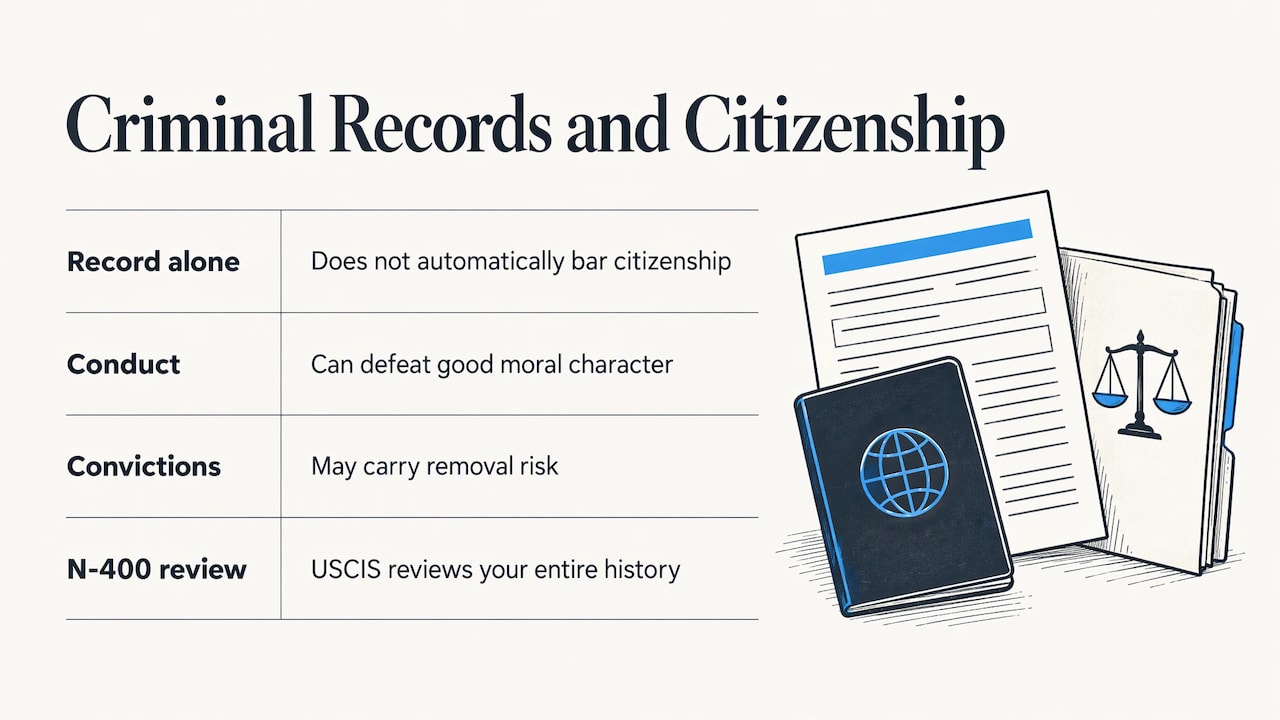
A criminal history is not an automatic disqualifier. Official guidance from the LA County Office of Immigrant Affairs says that an arrest or conviction does not by itself mean you cannot become a citizen, and that many people with records remain eligible. It also notes that some conduct can defeat the good moral character requirement and that certain convictions carry serious immigration consequences, including removal risk for lawful permanent residents.
That last point matters most for you. Naturalization is not a paperwork exercise for someone with a record. When you file Form N-400, you ask USCIS to review your entire history. For a permanent resident with a conviction, the same facts that affect good moral character can also bear on whether you may remain in the country. The question to answer first is not “will I qualify?” but “what does my record look like to an immigration officer, and is it safe to file?”
What good moral character means
To naturalize, you must show good moral character, often shortened to GMC. Under 8 CFR 316.10, the burden is on you, and the period that counts runs through the oath of allegiance, not just until you file. USCIS judges your character against the standards of the average citizen in your community. It may also look at conduct before the statutory period if that conduct bears on who you are now.
In practice, offenses fall into three groups.
Permanent bars
Some offenses can never be overcome. According to the USCIS Policy Manual, a conviction for murder at any time, or for an aggravated felony on or after November 29, 1990, permanently bars you from establishing good moral character. “Aggravated felony” is an immigration term, not an everyday one. It covers a long list of offenses in the immigration statute, and some of them are not felonies under state law. Some require a court-ordered term of at least one year, even if the sentence was suspended. A theft or drug case that looked minor in criminal court can carry a very different label in immigration court, which is why the sentence imposed and the exact statute of conviction matter.
Conditional bars
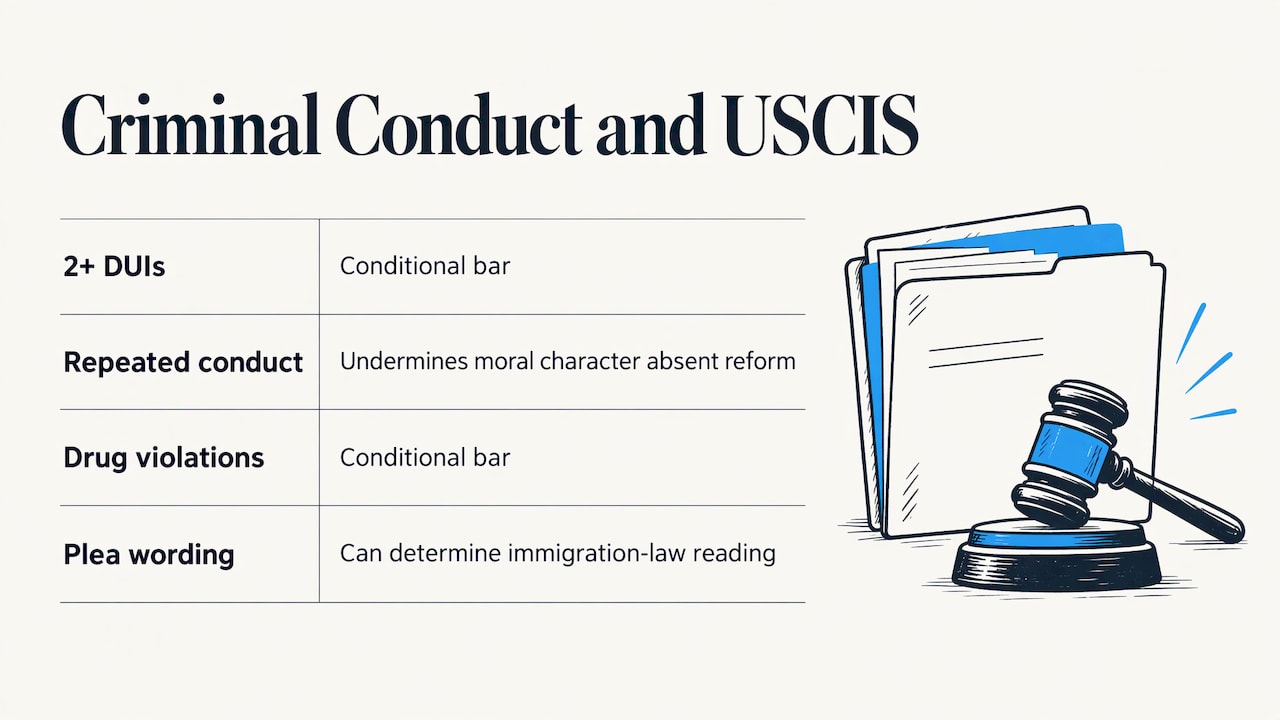
Other problems are temporary. The Policy Manual explains that conditional bars are triggered by specific acts, offenses or convictions within the statutory period, which generally means the five years before filing (three for some spouses of citizens), through the oath. They are not permanent. Once the offense falls outside that window, and you can show reform, you may be able to apply. Examples of conditional bars named in USCIS’s 2025 guidance include controlled-substance violations, two or more DUI convictions, a false claim to U.S. citizenship, and unlawful voting or voter registration.
Timing is the practical lever here. Someone who files too early can be denied, while someone who waits until the period has run and builds a record of good conduct can have a strong case. Knowing exactly when your clock ends requires the actual court documents, not memory.
Offenses that appear on no list
The last group surprises people. An offense outside any listed bar can still weigh against you, and the “unlawful acts” provision does not require a charge or conviction. The Policy Manual says the officer asks whether the act was unlawful, whether it occurred in the period, whether it reflects badly on your character, and whether extenuating circumstances exist.
When an offense involves moral turpitude (broadly, conduct considered inherently dishonest or base) or a controlled-substance law, the officer reviews the statute in the state where the offense occurred. In New York, that means the details of the specific Penal Law section matter, not just the name of the charge.
DUIs, drug charges and repeat offenses
One DUI and several DUIs are treated very differently. USCIS’s 2025 guidance lists two or more DUI convictions as a conditional bar. The same memorandum cites a 2019 Attorney General decision, Matter of Castillo-Perez, for the principle that repeated criminal conduct such as multiple DUIs undermines moral character unless you rebut it with affirmative evidence of reform. If you are dealing with a DUI right now, the early steps taken in the criminal case can affect the immigration outcome, as explained in this guide to immigration consequences of a DUI.
Drug cases deserve special care. Controlled-substance violations are a conditional bar, and the way a plea is worded can decide how immigration law reads it. A plea that seems like a good deal in criminal court can be the opposite for a non-citizen. If you have a pending case, the criminal outcome and the immigration plan should be considered together.
What you must disclose on Form N-400
The form asks about your whole life, anywhere in the world. USCIS’s eligibility guide states that all offenses must be reported, including expunged ones and those committed before age 18, and that if USCIS discovers an undisclosed offense, you may be denied even where the original offense alone would not have caused a denial.
That means you should list:
- Every arrest, citation, detention or charge, even if the case was dismissed.
- Offenses that were sealed, expunged or otherwise cleared.
- Juvenile matters.
- Cases resolved through diversion, deferred prosecution, a suspended sentence, probation, parole, a pardon or clemency.
- Matters from outside the United States.
A state’s expungement does not erase a record for immigration purposes. Rules for clearing records differ widely by state, as seen in how expungement works in Massachusetts, but the N-400 asks about the event itself, however a court later treated it. A judge, clerk or defense lawyer may have told you that you “don’t have to mention” an old case. For this form, the safe course is to disclose and explain.
The USCIS guide also says that traffic incidents that were not alcohol- or drug-related, involved no actual arrest, and ended with only a fine under $500 and/or points on your license need no documentation. Anything involving an arrest, or alcohol or drugs, needs certified documents: the arrest report, the court disposition, and sentencing records, plus any evidence in your favor.
How USCIS finds out
Assume USCIS will see it. According to the Policy Manual’s background-check chapter, USCIS requests an FBI name check on every naturalization applicant. It also runs other security checks to review criminal history and verify what the application says. The same chapter says USCIS must investigate every applicant, covering at least the five years before filing, and that the neighborhood investigation can include interviews with witnesses about conduct, residence and reputation.
The naturalization examination chapter adds that the officer must make sure background and security checks are complete and still valid when the case is decided. If USCIS intends to deny on derogatory information, it must give you notice and a chance to answer it. That chance to respond is where prepared documents and a clear explanation make a difference.
What the 2025 guidance means for rehabilitation
On August 15, 2025, USCIS issued policy memorandum PM-602-0188 on how officers evaluate good moral character. It directs a look at the totality of circumstances. Officers are told to give weight to positive attributes: community involvement, caring for family, education, stable lawful employment, length of lawful residence and tax compliance. They are also told to scrutinize disqualifying behavior more closely, including some conduct that is technically lawful, such as reckless or habitual traffic infractions.
The same memorandum places greater attention on rehabilitation. Evidence it lists as supportive includes:
- Catching up on overdue child support.
- Complying with probation.
- Testimony from credible people in your community.
- Paying overdue taxes in full.
- Repaying overpaid benefits in full.
- Mentoring others with similar pasts.
It also confirms the preponderance-of-the-evidence standard: you must show it is more likely than not that you meet each requirement, including good moral character. Documents win on that standard. A tax transcript, a probation completion letter, a payment record or a letter from a pastor, employer or coach turns “I have changed” into something an officer can weigh. The Policy Manual adds that character reference letters are weighed for credibility and detail, though the absence of letters alone is not grounds for a finding against you.
A practical path before you file
- Write down your full history. List every arrest, citation and charge in any country, with dates and places. Memory fails, and this list becomes the base for your answers on the N-400.
- Collect certified court records. Request the arrest report, the disposition and the sentencing documents for each incident. Certified copies are what USCIS asks for, and missing ones are a common reason for delay. Our office reviews these records with you to see how immigration law reads each one, using the statute of conviction rather than the charge’s label.
- Work out your clock. Identify which offenses, if any, fall inside the statutory period, and when it ends. This tells you whether to file now or wait, and a wrong guess can mean a denial and a lost fee.
- Check for removal risk. For a permanent resident, some convictions are a deportation issue regardless of citizenship. Our firm also handles deportation defense, so your naturalization plan is built with that risk in view.
- Build your evidence of reform. Gather tax transcripts, proof of payments, probation completion and letters from people who know you well.
- Prepare for the interview. The officer will ask about your answers in person. Being able to explain each incident consistently and truthfully, in English or with Spanish-language preparation beforehand, protects you from disclosure problems.
If you also have fees, conditions or other status issues to sort out, such as a conditional green card, those are best dealt with before you apply for citizenship.
Naturalization help in Central New York
If you live in Syracuse, Utica, Rome, Binghamton, Fort Drum or elsewhere in Onondaga and Jefferson counties, our office represents people who want to become citizens, including those whose histories need careful handling. You deal directly with attorney Craig K. Nichols, who communicates with you personally and knows how immigration matters move in this region.
Learn how we handle citizenship cases on our naturalization page, or read about our naturalization work in Syracuse. Families going through other steps can find our family immigration services here.
Our perspective
For nearly 30 years I have sat across the table from people who were afraid to ask the question that matters most: can I still become a citizen after what happened?
Most of the time the answer is more hopeful than people expect, but only when the facts are looked at honestly and early. A record is a set of documents, dates and statutes. Each one can be read, and each has an answer. What hurts people is guessing: filing before the clock has run, leaving off an old case because a judge once said it was sealed, or walking into an interview unable to explain a mistake from fifteen years ago.
That is why I handle these cases personally. You talk to me, not to a rotating group of staff, and we can work in English or Spanish so that nothing is lost in translation. Citizenship is a milestone for a whole family, and a careful plan is the lifeline that gets you there.
Craig Nichols
FAQ
Can I apply for citizenship if I have a criminal record?
Often yes, but not always. Murder and aggravated felonies since November 29, 1990 are permanent bars, and other offenses can block you temporarily. Because filing can also expose a permanent resident to removal proceedings in some cases, have an immigration attorney review your records before you apply.
Do I have to list an arrest that was dismissed or an expunged conviction?
Yes. Form N-400 asks about every arrest, citation, detention and charge, including sealed, expunged and juvenile matters and cases that were dismissed. USCIS guidance warns that failing to disclose an offense can lead to a denial even where the offense itself would not have caused one.
Can USCIS see police reports and court records?
USCIS runs FBI name checks and other security checks on every naturalization applicant, and it asks you to submit certified arrest and court documents for any incident beyond minor traffic matters. Plan on the officer knowing what is in your record.
How long will the background check take?
The time varies by case, and USCIS must finish all background and security checks before the examination. A criminal history can mean extra document requests. Check USCIS’s processing times page for current figures for your local office, and bring complete certified records so your case is not held up.
Sources
- Becoming a U.S. Citizen, LA County Office of Immigrant Affairs
- 8 CFR 316.10, Good moral character (eCFR)
- USCIS Policy Manual, Vol. 12, Part F, Chapter 4: Permanent Bars
- USCIS Policy Manual, Vol. 12, Part F, Chapter 5: Conditional Bars
- USCIS Policy Manual, Vol. 12, Part F, Chapter 2: Adjudicative Factors
- USCIS guide: Who Is Eligible for Naturalization, Chapter 4
- USCIS Policy Manual, Vol. 12, Part B, Chapter 2: Background Investigation and Security Checks
- USCIS Policy Manual, Vol. 12, Part B, Chapter 3: Naturalization Examination
- USCIS Policy Memorandum PM-602-0188, August 15, 2025
- Immigration consequences of a DUI
- Expungement in Massachusetts