

A conditional green card is a two-year permanent resident card given mainly to people who become residents through a marriage that was less than two years old on the day they got their status. It does not renew. To keep your status, you must file Form I-751, the Petition to Remove Conditions on Residence, in the 90 days before the card expires. The process is manageable when you start on time and organize your evidence, and it is where an experienced immigration attorney can lift a heavy load from you and your family.
At Nichols Law Offices, PLLC, attorney Craig K. Nichols has spent nearly 30 years helping families in Central New York with green cards and family immigration, and he works with clients one-on-one. This guide explains the rules in plain language so you know what to do and when.
Key Takeaways
- Your green card is conditional if it is based on a marriage that was less than two years old when you received permanent resident status. The card is valid for two years and says so on its face.
- You must file Form I-751 within the 90-day window before the card expires. Missing it can end your permanent resident status and make you removable from the United States.
- Evidence of a good-faith marriage, from the wedding day to today, is the heart of the petition.
- If you are divorced, separated, or abused, you may be able to request a waiver of the joint filing requirement instead.
- A properly filed petition extends your card and work authorization while USCIS decides your case.
Table of Contents
- What Is a Conditional Green Card?
- Who Receives a Two-Year Green Card
- How to Tell Whether Your Card Is Conditional
- When to File Form I-751
- What Happens If You Miss the Deadline
- Your Status While USCIS Reviews the Petition
- What to Include in a Joint Petition
- If You Cannot File Jointly: Waivers
- Do You Need an I-751 Attorney?
- Perspective
- Work With Nichols Law Offices
- FAQ
- Sources
What Is a Conditional Green Card?
A conditional green card shows that you are a permanent resident on a trial basis. The law behind it, the Immigration Marriage Fraud Amendments of 1986, gives conditional status for two years when you obtain residence through a marriage that began less than two years earlier. The purpose is to confirm that the marriage was real and not entered into to obtain immigration benefits.
USCIS describes a conditional resident as someone granted permanent residence on a conditional basis, such as a spouse of a U.S. citizen or an immigrant investor, who must petition to remove the conditions before the second anniversary of the approval date.
You are a lawful permanent resident during these two years. You can live and work in the United States, and you can travel and return. The difference is that your status has an expiration date and a required next step.
Who Receives a Two-Year Green Card
Most conditional green cards come from three situations:
- Marriage to a U.S. citizen or permanent resident that is less than two years old on the day you obtain residence. This is the most common case, and it applies whether you adjust status inside the U.S. or enter on an immigrant visa. The USCIS Policy Manual says the basis is a Form I-130 or Form I-129F petition.
- Fiancé(e) visa (K-1) holders who marry their U.S. citizen sponsor after arriving and then apply for a green card. Because the marriage is new, the green card is conditional.
- Immigrant investors, who file Form I-829 instead of Form I-751. This article focuses on the marriage-based petition.
Some people are not conditional residents. The Policy Manual lists, among others, a spouse whose marriage was more than two years old when they got residence, and anyone who obtained residence on a basis other than marriage. If you married a U.S. citizen three years ago, you would normally receive the standard 10-year card.
How to Tell Whether Your Card Is Conditional
Check three things:
- The expiration date. A conditional card is valid for two years from the date you obtained conditional residence, not ten.
- The approval notice. Your approval notice and the way your case was decided will show whether your marriage was under two years old at approval.
- The category code on the card. Cards for spouses in conditional status usually carry a different code from the ones on 10-year cards. If you are unsure, ask your attorney to review the card and your approval notice.
If your card expires in two years and you got it through marriage, plan on the I-751 process.
When to File Form I-751
For a joint petition with your spouse, USCIS requires you to file within the 90-day period immediately before your green card expires. That means the clock starts about three months before the expiration date printed on the card. The Policy Manual explains that the 90 days are counted back from the second anniversary of conditional residence, and USCIS offers a Filing Date Calculator on its “When to File Your Petition to Remove Conditions” page.
A few points families often miss:
- Filing early can get the petition rejected. The window is a rule, not a suggestion.
- Do not wait for the last week. Collecting joint bank statements, leases, and affidavits takes longer than most people expect.
- Military and government assignments overseas. The statute suspends the 90-day period while the conditional resident or the petitioning spouse is abroad on military or government orders. For military families around Fort Drum, that can matter a great deal, and the filing needs additional items such as photos and fingerprint cards.
What Happens If You Miss the Deadline
USCIS states that if you do not file, your conditional status automatically ends two years after it was granted and you become removable. USCIS then sends a notice and can start removal proceedings with a Notice to Appear.
A late filing is not always the end. If you file after the window, you must include a written explanation. USCIS may excuse the delay if it was due to extraordinary circumstances beyond your control and the length of the delay was reasonable. If you have already missed the date, or if you have received a termination notice, speak with an attorney right away. We handle deportation defense for people in this situation.
Your Status While USCIS Reviews the Petition
After you file, you will receive a receipt notice (Form I-797). USCIS explains that in January 2023 it extended the validity of green cards for people who properly file Form I-751 by 48 months beyond the card’s expiration date. The receipt notice also extends your conditional status and work authorization for 48 months. If your case is still pending after that, USCIS tells petitioners to call its Contact Center at 800-375-5283.
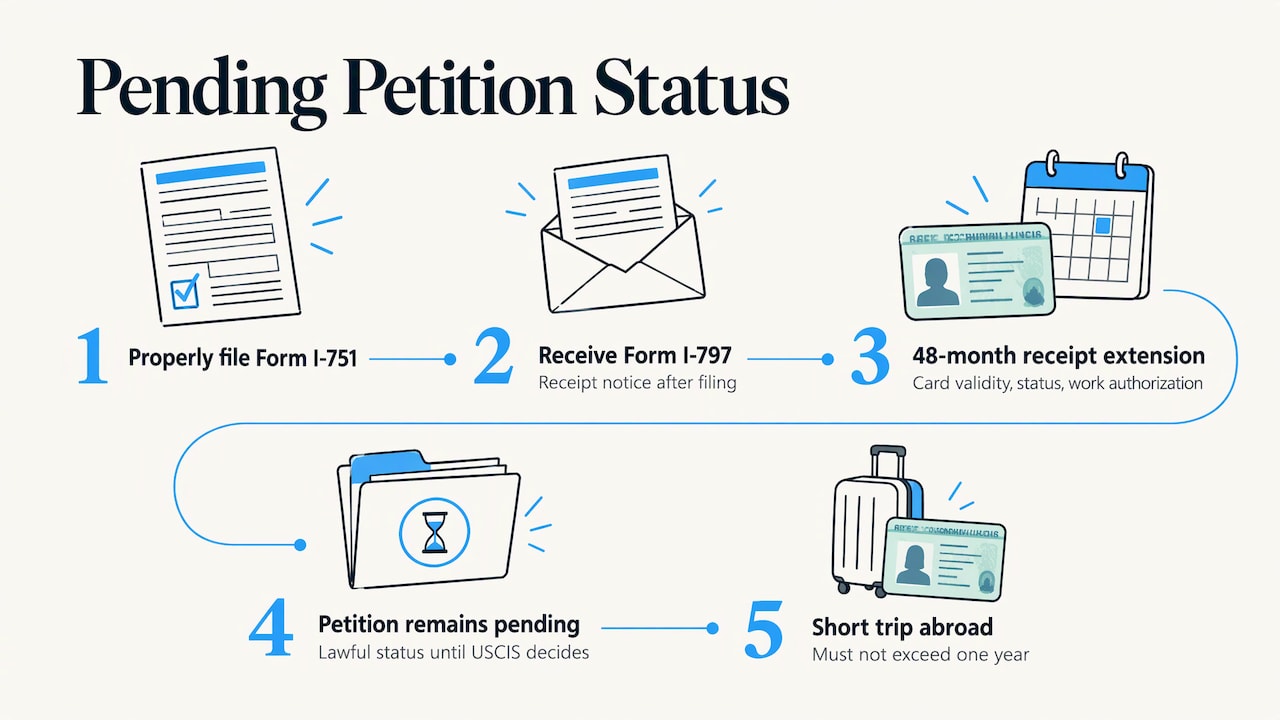
In general, a conditional resident remains in lawful status until USCIS decides the petition, as long as it was properly filed. The receipt notice together with your expiring or expired card is evidence of your status, including for employment and for returning after a short trip abroad.
Travel needs care. A green card is valid for readmission only if the trip is not longer than one year. If you plan to leave the country while your petition is pending, read our guide on international travel with a green card and carry both the card and your receipt notice.
What to Include in a Joint Petition
The I-751 instructions ask for a copy of the front and back of your green card and evidence that the marriage was entered in good faith. USCIS refers filers to its fee schedule for the current filing fee, so check the official fee page the week you file, since fees can change. USCIS may also ask for biometrics (fingerprints and photo) or an interview.
USCIS asks you to submit copies of as many documents as possible showing the relationship from the date of marriage to the present. Strong evidence usually includes:
- Joint leases, mortgages, or deeds showing a shared home
- Joint bank accounts, credit cards, tax returns, and insurance policies
- Utility bills and mail addressed to both of you at the same address
- Birth certificates of children born to the marriage
- Photographs across the full two years, with family and friends, and travel records
- Affidavits from people who know you as a couple
Affidavits are useful, but USCIS notes they must be supported by other evidence, and the people who write them may be asked to testify before an immigration officer. Documents carry the case. Statements add detail.
Common mistakes in a joint filing
- Filing before the 90-day window opens
- Leaving out the spouse’s signature on a joint petition
- Submitting only wedding photos and nothing from the second year
- Not sending a change of address to USCIS, so the interview notice goes to an old address
- Responding late or incompletely to a request for evidence
If you receive an interview notice, USCIS will tell you when and where to appear and what you need to bring to show you qualify. Preparing for that interview, and for questions about your daily life together, is a good moment to have your attorney beside you.
If You Cannot File Jointly: Waivers
Not every marriage lasts the full two years, and not every spouse will cooperate. The law allows you to request a waiver of the joint filing requirement on these grounds, according to the USCIS Policy Manual:
- Extreme hardship if you were removed from the United States
- A good-faith marriage that ended other than by the death of your spouse, such as divorce
- Battery or extreme cruelty by your spouse, or in specified cases by a parent or stepparent
A waiver can be filed before, during, or after the 90-day period, but only until an immigration court issues a final order of removal. That flexibility matters if your relationship has ended well before the two-year point. Divorce brings its own questions, especially where spouses live in different states, and a family law resource on filing for divorce in another state explains how residence and jurisdiction work for military members, international spouses, and people who move.
Waiver cases are evidence-heavy. You need to show the marriage was real from the start and explain how it ended or why you cannot file with your spouse. If abuse is part of the story, we treat it with care and confidentiality. Victims of certain crimes may also have a separate path through a U-visa, which we can discuss with you.
Do You Need an I-751 Attorney?
Many couples with clear records file on their own. You should seriously consider a lawyer when:
- You are divorced, separated, or your spouse will not sign
- You are filing a waiver, including one based on abuse or extreme hardship
- You missed the 90-day window or your card has already expired
- You have a criminal record, a prior immigration violation, or an earlier denial
- You received a request for evidence or an interview notice you do not understand
- You are in removal proceedings
- You or your spouse are stationed or living overseas on military or government orders
In these cases, a small mistake can cost you your status, not just time. A lawyer chooses the right filing basis, organizes the evidence into a persuasive package, prepares you and your spouse for questions, and speaks for you if USCIS or the court raises a problem. Even in a straightforward case, many clients simply want to know the petition is complete before it goes out.
Perspective
When families come to us with a two-year card, they are usually not worried about the law. They are worried about their home, their children, and the person they love. A conditional card can feel like a clock that is always running.
Our approach is simple: we start early, we gather the evidence with you, and you speak directly with the attorney handling your case. In nearly three decades of serving Central New York, I have found that families do best when they understand each step before it happens. We communicate in English and Spanish so that you and your spouse are both comfortable with every document you sign.
Whether your case is a straightforward joint petition, a waiver after a divorce, or a matter that has reached removal proceedings, you deserve a lawyer who knows the local process and treats your family’s future as seriously as you do.
Craig Nichols
Work With Nichols Law Offices
If you hold a conditional green card in Syracuse, Utica, Rome, Binghamton, or the Fort Drum area, we can review your card, your dates, and your evidence with you. Our team handles green card cases, family immigration, and deportation defense, with bilingual support in English and Spanish.
Contact Nichols Law Offices through our website to speak with Craig Nichols about removing the conditions on your residence. Once you are a permanent resident for the required period, we can also help you plan for naturalization.
FAQ
Is a conditional green card the same as a permanent green card?
You are a lawful permanent resident either way, with the right to live and work in the United States. The difference is that a conditional card lasts two years and cannot be renewed, so you must file a petition to remove conditions. USCIS states that failing to file in time means losing permanent resident status.
When should I remove conditions on my green card?
File Form I-751 during the 90 days before the card’s expiration date, not earlier. Use the Filing Date Calculator on the USCIS website to confirm your dates. If you need a waiver, you can file it before, during, or after that window, but not after a final removal order.
Can I work and travel while my I-751 is pending?
Yes, in general. Your receipt notice extends your card and work authorization, and USCIS says it does so for 48 months. For travel, carry your card and the receipt notice, and keep trips well under a year.
What if my spouse and I divorced before the two years ended?
You may still remove the conditions by requesting a waiver if you entered the marriage in good faith. You will need strong evidence of the relationship and proof of how it ended. This is a case where an attorney’s guidance is especially valuable.
Sources
- USCIS: Removing Conditions on Permanent Residence Based on Marriage
- USCIS: Conditional Permanent Residence
- USCIS: After We Grant Your Green Card
- USCIS: Conditional resident glossary entry
- USCIS alert on family-based conditional permanent residence guidance
- USCIS Policy Manual, Volume 6, Part I, Chapter 2
- USCIS Policy Manual, Volume 6, Part I, Chapter 4
- USCIS Policy Manual, Volume 6, Part I, Chapter 5
- USCIS Form I-751 instructions
Recommended
- Adjustment of Status: How to Get a Green Card Without Leaving the U.S.
- Adjustment of Status in Syracuse, NY: How to Get a Green Card Without Leaving the U.S. (2026 Guide)
- International Travel with a Green Card in 2026: What Syracuse Residents Need to Know Before Leaving the U.S.
- Green Card Sponsor Income: What You Must Earn to Sponsor a Parent