
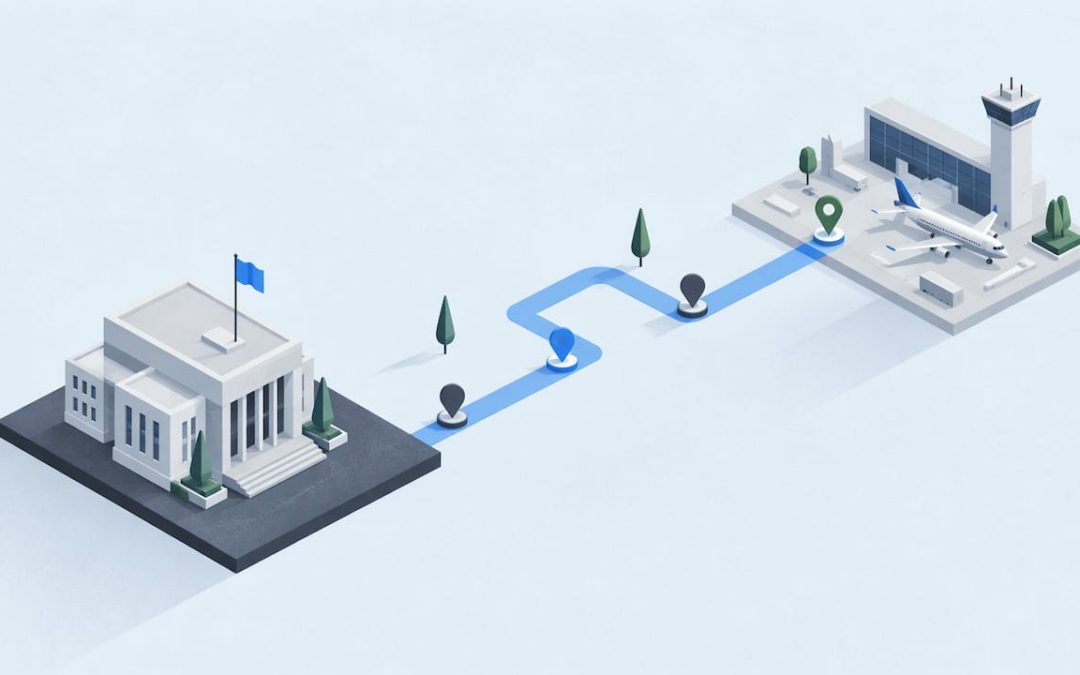
Consular processing is how a person who is outside the United States becomes a permanent resident: you apply for an immigrant visa at a U.S. embassy or consulate abroad, and you are admitted as a green card holder when you arrive. The path is set by the U.S. Department of State and USCIS, and it has more moving parts than most families expect. A petition, a transfer between agencies, document review, an interview and a final entry all have to line up. At Nichols Law Offices, PLLC, Craig Nichols guides families in Syracuse and across Central New York through each of these stages directly, in English and Spanish.
Key Takeaways
- Consular processing is for people who are outside the U.S. and qualify for an immigrant visa, most often through a petition from a family member or employer.
- The process has two halves: USCIS decides the petition, then the National Visa Center (NVC) and a consulate handle the visa itself.
- Most delays happen at document review, interview scheduling and administrative processing, and the State Department says no one can speed up the last of these.
- Accuracy matters at every stage: incomplete or untrue answers can delay a visa or make an applicant ineligible.
- A refusal is not always the end. Some applicants can ask whether a waiver is available.
Table of Contents
- What consular processing means, and who uses it
- The consular processing steps, from petition to green card
- How long consular processing takes
- Administrative processing: when the interview does not end in a decision
- Fees to plan for
- If the visa is refused
- When a lawyer makes a difference
- Our view on consular processing
- Getting help with your case
- FAQ
- Sources
What consular processing means, and who uses it
The name sounds technical, but the idea is simple. There are two ways to get a green card. If the person is already inside the U.S. and eligible, they can sometimes apply from within the country, which is called adjustment of status. If the person lives abroad, or cannot adjust for another reason, they go through a U.S. consulate. That second route is consular processing.
According to USCIS, most immigrants become eligible through a petition filed on their behalf by a family member or an employer. Others qualify through special provisions. The diversity visa lottery is another entry point, and Nolo’s overview of the process groups the main categories as family, employment and the lottery.
In our practice, the people who come to us about consular processing are usually in one of these situations:
- A U.S. citizen or green card holder wants to bring a spouse, child, parent or sibling to live in Central New York.
- A service member or veteran at Fort Drum has a relative abroad and wants to understand the options for the family.
- A newly naturalized citizen wants to petition for a relative who has been waiting overseas.
- A person who lives in the U.S. without status has learned that leaving the country to attend an interview can create serious problems of its own.
That last situation deserves care. Anyone who has lived in the U.S. without lawful status should speak with an immigration attorney before making any plan that involves leaving the country, because the trip abroad itself can change what the consulate is allowed to approve.
The consular processing steps, from petition to green card
USCIS lists eight stages. Here they are in plain language, with where each one tends to go wrong.
Step 1: Determine your basis to immigrate
Every case starts with a legal reason the government can recognize: a qualifying family relationship, a job offer or another special category. This is where many families make their first mistake. They assume a relationship is enough, when the category (spouse of a citizen, child of a permanent resident, sibling and so on) determines the form, the wait and the documents.
Our family immigration page explains how these categories work for families in our region. Choosing the right one at the start is far easier than correcting it two years later.
Step 2: File the immigrant petition
The petitioner files the form that matches the category. USCIS names Form I-130 for family cases, I-140 for employment, I-526 for investors and I-360 for certain special categories. The State Department notes that the I-130 filing fee is charged by USCIS, separate from the visa fees paid later.
Where it goes wrong: missing proof of the relationship, inconsistent names or dates across documents, and a petitioner who cannot show the status they claim. A petition that is rejected or sent back for more evidence costs months.
Step 3: Wait for a decision on the petition
USCIS reviews the petition and either approves it, asks for more evidence, or denies it. Nothing happens abroad during this stage. If you receive a request for evidence, the deadline in the notice is firm, and a thorough response is worth the time it takes.
Step 4: The case moves to the National Visa Center
After approval, USCIS transfers the case to the NVC, part of the State Department. Per the NVC Processing page, the NVC first creates your case in its system, then sends a Welcome Letter by email or mail with the information you need to log in to the Consular Electronic Application Center (CEAC), the online portal where the case is managed.
The NVC collects visa application fees and supporting documents. It also tells the petitioner and the applicant when a visa number is about to become available. Families who lose track of NVC emails, or whose address changes, can miss notices that carry deadlines.
The State Department also says that if you already have an attorney, the NVC will not instruct you to complete Form DS-261, the Choice of Address and Agent form. That is one small example of how representation changes the mechanics of the case.
Step 5: Submit documents and fees, and wait for the interview
You complete the immigrant visa application (Form DS-260), pay the fees and upload civil documents such as birth and marriage certificates, police certificates and the financial support paperwork. The NVC then reviews the file to make sure everything required to schedule the interview is there, and interviews depend on appointment availability at the embassy or consulate.
This is the stage where most files stall. A blurry scan, a missing translation or a name spelled two ways can send a file back for correction. Each round trip adds weeks. Documents from some countries are hard to obtain, and knowing in advance what a consulate will accept saves a great deal of time.
Step 6: Complete the medical exam and attend the interview
Before the interview, the applicant completes a medical examination with an approved physician. The State Department says that medical exam and vaccination costs vary, and that applicants should also budget for translations, photocopies, document fees and travel.
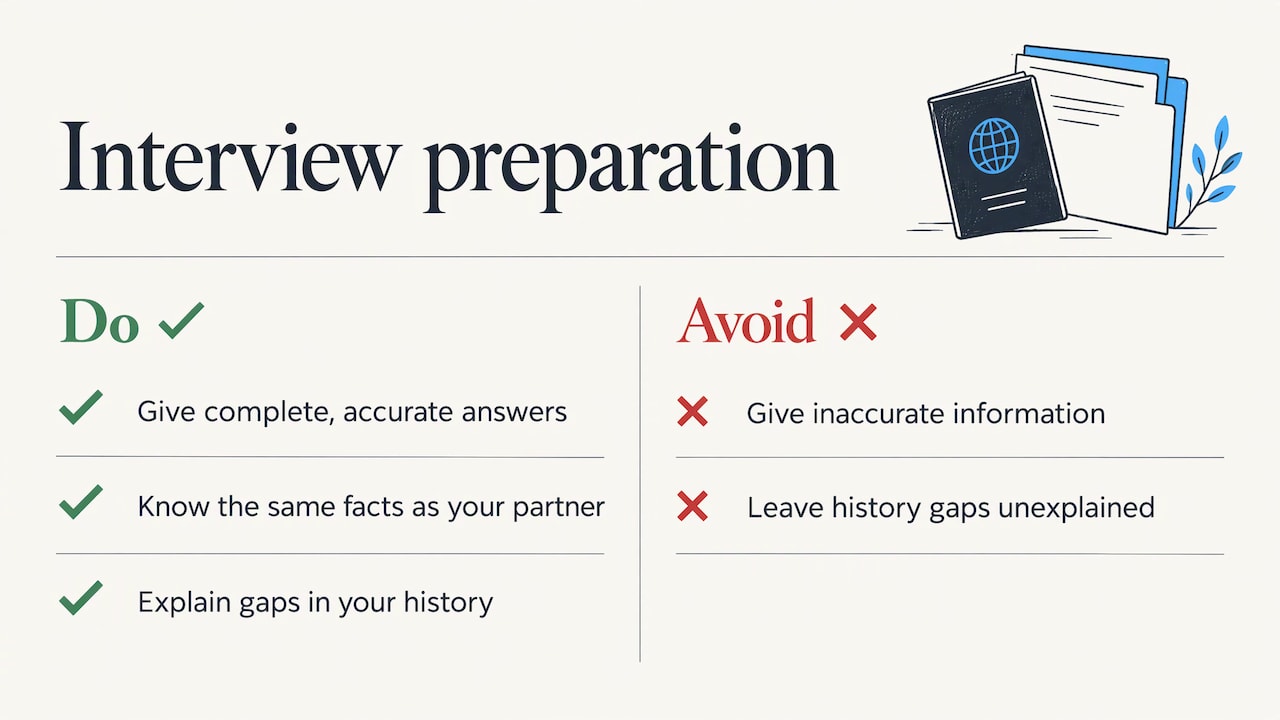
At the interview, a consular officer asks about the relationship, the petition and the applicant’s background. The U.S. Embassy in Canada reminds applicants that you must tell the truth and give complete, accurate information throughout the process. If you do not, the visa can be delayed or you can be found ineligible.
Preparation here is mostly about consistency. The officer compares what you say with what the petition and documents say. Couples should know the same facts about each other’s lives, and applicants should be ready to explain any gap in a history, such as an old arrest, a past visa problem or a stay that ran past its authorized date.
Step 7: Visa issued, immigrant fee paid, entry to the U.S.
If the visa is granted, you pay the USCIS Immigrant Fee and present your sealed Visa Packet to Customs and Border Protection at the port of entry. USCIS lists these as the final steps before the card arrives. You are admitted as a permanent resident, and the physical green card follows by mail.
Keep the packet sealed until the officer asks for it, and make sure your mailing address is correct, because the card is mailed to the address you give.
How long consular processing takes
Nobody can honestly give a single number, and the government does not either. The wait depends on the category, the country, the consulate’s appointment capacity and whether your file is complete.
What the official sources do say:
- The State Department’s NVC has said its document review turnaround has varied significantly over time, and that each case differs.
- Published appointment wait times on the Visa Appointment Wait Times page do not include time for administrative processing.
- Some family categories also depend on visa number availability, so the petition can be approved long before a visa number is ready.
The practical advice is to treat the timeline as a series of waiting periods rather than one. Your control over each one is different. You cannot change how fast USCIS or a consulate works, but you can control how complete and correct your file is, and that is where most avoidable delay comes from.
Administrative processing: when the interview does not end in a decision
Sometimes a consular officer finishes the interview and tells you the case needs more review. The State Department explains that when administrative processing is required, the officer informs the applicant at the interview, and that its duration varies by case. After it ends, the officer may find the applicant eligible or still ineligible.
Two points from official guidance are worth knowing:
- Except for emergencies such as a serious illness or death in the immediate family, applicants should wait at least 180 days from the interview or from the date they submitted supplemental documents, whichever is later, before asking about status.
- Johns Hopkins University’s international office notes that the outcome is at the full discretion of the State Department, and that no outside party can control the speed. Once it starts, it runs until it is complete.
This is a stressful stage for families, and the honest answer is that waiting is part of it. What a lawyer can do is make sure that any documents the consulate requests are submitted promptly and correctly, and that you know when an inquiry is appropriate and when it is premature.
Fees to plan for
Budget for several separate payments. The State Department’s spouse visa page lists the main categories of cost: the USCIS filing fee for the petition, the visa application processing fee, the medical exam and vaccinations, and other costs such as translations, copies, document fees and travel. After the visa is issued, there is also the USCIS Immigrant Fee.
Fee amounts change when agencies publish new schedules, so confirm each one on the official USCIS and State Department fee pages before you pay. Paying the wrong amount, or paying a third-party site that is not the government, is one more way cases get delayed.
If the visa is refused
A refusal feels final, but it is often a request to fix something. The State Department states that a complete application has two possible outcomes, issue or refuse, and that if eligibility is not established, the officer must refuse, sometimes with further processing to follow.
According to USAGov, if your application is denied you have the right to ask why, and to ask whether you are eligible for a waiver of the ground of inadmissibility. If a waiver is approved, a visa may then be issued.
Waivers depend on the specific ground and on facts such as a qualifying relative’s hardship. These are exactly the cases where the quality of the written evidence decides the result. We handle rehabilitation applications and waivers as part of our practice, and a refusal notice is a good reason to call us before the next deadline passes.
When a lawyer makes a difference
Some families complete consular processing on their own, and the forms are public. But certain situations call for legal advice:
- A past immigration violation. Overstays, prior removals, unlawful entry or false claims can create bars that a consulate will raise at the interview.
- Criminal history of any kind. Even old or minor matters should be reviewed before the interview, not at it.
- Complicated family situations. Prior marriages, children from other relationships, adoption or same-sex marriage cases, where documents need careful assembly.
- Military families. Service members and their relatives may have options such as Parole in Place, which can change whether consular processing is needed at all. Our military immigration page covers those options.
- Uncertainty about whether to leave the U.S. Someone inside the country may be able to adjust status instead, and our adjustment of status guide explains when that route is open.
- Any refusal or administrative processing. The next move needs to be deliberate.
For a deeper walk through the category side of the process, our guide to getting an immigrant visa in Syracuse is a good companion to this article.
Our view on consular processing
Families rarely come to us worried about a form. They come worried about a person: a spouse who has been abroad for a year, a parent they have not hugged in a decade, a child waiting for a decision no one can predict.
Consular processing is a long road with several different offices involved, and the families who do best are the ones who know in advance where each step can go wrong. That means choosing the right category at the start, building a file that is complete and consistent before it is ever reviewed, and preparing for the interview as carefully as for the petition.
Our approach is direct. You speak with your attorney, not a rotating cast of staff. We communicate in English and Spanish, and after nearly 30 years in Central New York we know the local picture well: the families in Syracuse, Utica, Rome and Binghamton, and the service members at Fort Drum. A clear explanation, given early, is a lifeline when the process feels out of your hands.
Craig Nichols
Getting help with your case
If a relative abroad is waiting on an immigrant visa, or you are deciding between consular processing and another route, the best time to talk to us is before you file or before the interview, not after a refusal. Our immigrant visas page explains how we handle these cases, from the petition through the consular stage.
We represent individuals and families across Syracuse, Onondaga County, Rome, Utica, Binghamton and Jefferson County, and our Nichols Law Offices home page lists how to reach us for a consultation.
FAQ
What is the difference between consular processing and adjustment of status?
Consular processing is done through a U.S. embassy or consulate abroad, and you are admitted as a permanent resident when you enter the U.S. Adjustment of status is filed with USCIS while the applicant is already in the country. Which one applies depends on where you are and on your immigration history, so it is worth getting advice before choosing.
What are the main consular processing steps?
You establish your basis to immigrate, a petition is filed and approved, the case moves to the National Visa Center, you submit forms, fees and documents, and you attend a medical exam and interview. If the visa is granted, you pay the USCIS Immigrant Fee and present your visa packet at the port of entry. The green card then arrives by mail.
How long does administrative processing last?
It varies by case, and the State Department cannot predict it. Official guidance says that, except in emergencies, applicants should wait at least 180 days after the interview or after submitting requested documents before asking about status.
Do I need a consular processing lawyer?
The forms are public, but a lawyer matters most when a case involves a past immigration violation, a criminal record, a complicated family history or a refusal. An attorney can prepare the file, get you ready for the interview and advise on waivers where they are available.
Can a refused applicant still get a visa?
Sometimes. A refused applicant has the right to ask why and whether a waiver of the ground of inadmissibility is available. If a waiver is approved, a visa may be issued.
Sources
- Consular Processing, USCIS
- NVC Processing, U.S. Department of State
- Immigrant Visa for a Spouse of a U.S. Citizen, U.S. Department of State
- Administrative Processing Information, U.S. Department of State
- Visa Appointment Wait Times, U.S. Department of State
- AILA Agenda, U.S. Department of State, 2023
- Administrative Processing and Visa Issues, Johns Hopkins Office of International Services
- Immigrant Visa Process, U.S. Embassy and Consulates in Canada
- What happens if your visa application is rejected, USAGov
- Consular Processing overview, Nolo
Recommended
- Adjustment of Status: How to Get a Green Card Without Leaving the U.S.
- Becoming a Permanent Resident in the United States: Your Guide from a Syracuse Immigration Attorney
- Adjustment of Status in Syracuse, NY: How to Get a Green Card Without Leaving the U.S. (2026 Guide)
- Naturalization Attorney: When to Hire One and What to Expect