

Adjustment of status is the process of applying for lawful permanent resident status (a green card) while you are physically in the United States. USCIS explains that if you are outside the country, you must instead get an immigrant visa through consular processing. For many families in Central New York, adjustment is the pathway that lets a spouse, parent or child stay at home while the case moves forward. Below, we walk through who qualifies, how the process works, what to expect while you wait, and when it makes sense to have an attorney beside you.
Key Takeaways
- Adjustment of status lets eligible people in the U.S. apply for a green card on Form I-485 without leaving the country for an immigrant visa interview abroad.
- You generally need a visa number available in your category, a lawful entry (inspected and admitted or paroled), and admissibility, or a waiver for what makes you inadmissible.
- Immediate relatives of U.S. citizens do not wait for a visa number, but the other requirements still apply.
- Leaving the U.S. while your I-485 is pending can end the application unless you hold advance parole or a qualifying status.
- Small mistakes, such as a missed biometrics appointment or an old address on file, can cost you the case, so careful preparation matters.
Table of Contents
- What Adjustment of Status Means
- Who Is Eligible to Adjust Status
- Visa Availability: The Rule That Decides When You Can File
- The Adjustment of Status Process, Step by Step
- While Your Application Is Pending
- Perspective
- When an Adjustment of Status Lawyer Makes Sense
- Green Card Renewal Is a Different Process
- Work With Nichols Law Offices
- FAQ
- Sources
What Adjustment of Status Means
Think of adjustment of status as the “inside the U.S.” route to permanent residence. You file Form I-485, USCIS reviews your eligibility, and if approved your status changes to that of a lawful permanent resident without a trip abroad.
Congress created the option for a practical reason. According to USCIS policy guidance, it lets certain people already present in the country become permanent residents without the expense and inconvenience of traveling abroad for an immigrant visa.
Adjustment versus consular processing
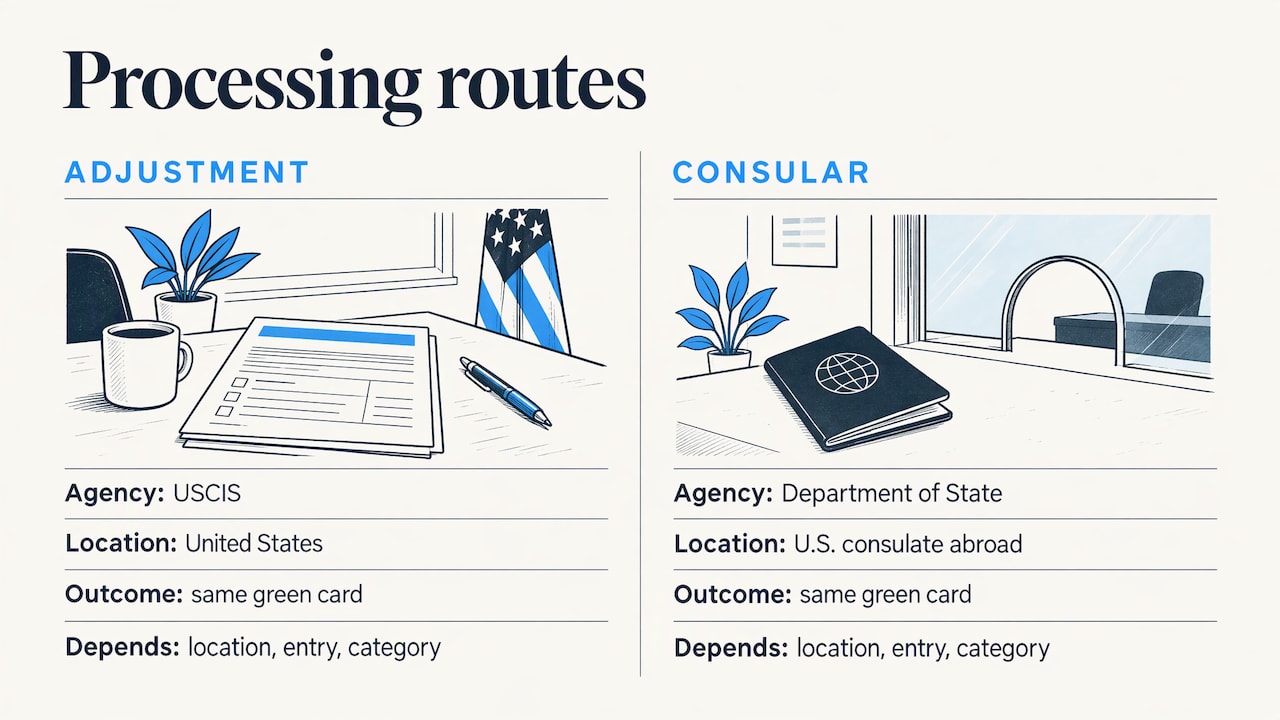
The two routes lead to the same card but run through different agencies. As Cornell’s Legal Information Institute notes, adjustment is handled by USCIS, while consular processing is handled by the Department of State at a U.S. consulate abroad. Which one applies to you depends on where you are, how you entered and what category you qualify under. Our page on immigrant visas covers the consular side if that is your situation.
Adjustment also looks at you personally. USCIS’s policy guidance frames the decision around the applicant’s own eligibility and admissibility, while the petition that comes before it looks at the relationship between sponsor and beneficiary.
Who Is Eligible to Adjust Status
The core rules come from section 245(a) of the Immigration and Nationality Act. USCIS’s Policy Manual says an applicant generally must:
- Have been inspected and admitted, or inspected and paroled.
- Be physically present in the United States.
- Properly file Form I-485.
- Be eligible to receive an immigrant visa.
- Have an immigrant visa immediately available, both when filing and at final decision.
- Be admissible, or eligible for a waiver or other relief.
- Merit a favorable exercise of discretion.
That last point surprises many people. Even when you meet every technical requirement, the officer weighs your whole record, so the way you present your history counts.
Common paths to a green card
Most adjustment cases we see fall into a few families of cases:
- Marriage to a U.S. citizen or permanent resident. A spouse of a citizen is an immediate relative.
- Other family-based categories, such as adult sons and daughters or siblings of citizens. Our guide to sponsoring a loved one for a green card explains each one.
- Fiancé(e) visa holders who marry the citizen sponsor after arriving and then adjust. See how the K-1 process works.
- Employment-based and special categories, including religious workers, certain crime victims and humanitarian cases.
- Military families, where Parole in Place can resolve an entry problem for certain relatives. Read about Parole in Place for military families.
Visa Availability: The Rule That Decides When You Can File
In general you may not file Form I-485 until a visa is available in your category. USCIS points applicants to its adjustment filing charts and the Visa Bulletin to check.
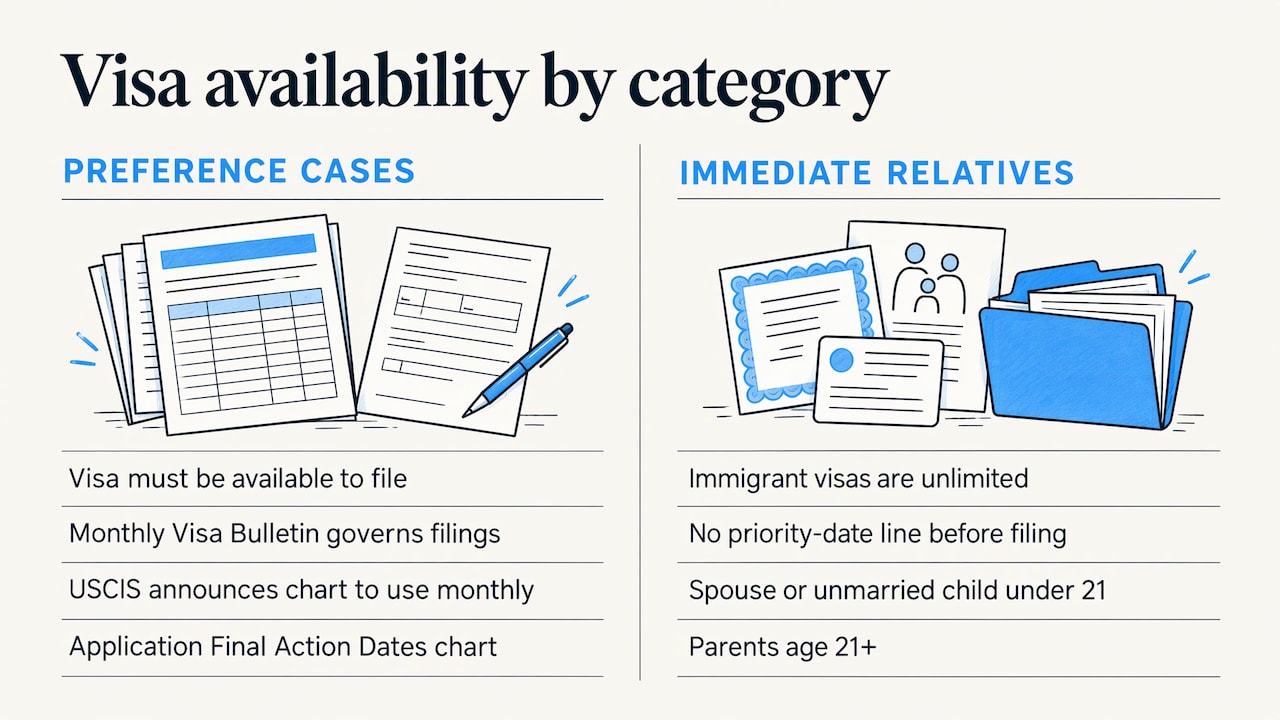
For family-sponsored and employment-based preference cases, USCIS accepts filings according to the monthly Visa Bulletin from the Department of State. USCIS notes that the bulletin has two charts, “Application Final Action Dates” and “Dates for Filing Applications,” and that USCIS announces which one applicants should use each month.
Immediate relatives are different. USCIS says their immigrant visas are unlimited, and it defines immediate relatives as the spouse, unmarried children under 21, parents (age 21 and over) and certain widows or widowers of U.S. citizens. If you fall in that group, no priority date line stands between you and filing.
Petition first, or both together
Adjustment generally requires an approved immigrant petition before you file the I-485. Some categories allow concurrent filing, meaning you file the I-485 while the petition is filed or still pending. Whether concurrent filing is open to you depends on the category, which is one of the first questions we answer at a consultation.
The Adjustment of Status Process, Step by Step
The path has a clear order, even if the timing varies from case to case. Based on USCIS’s description:
- Confirm eligibility and the right category. Choose the immigrant petition that fits your situation and check visa availability.
- File the petition, unless your category allows filing it together with the I-485.
- File Form I-485 with USCIS once you are eligible to do so.
- Attend the biometrics appointment. USCIS mails a notice and uses your fingerprints and photo for identity verification and required background and security checks.
- Respond to any request for evidence. USCIS may ask for more documents.
- Attend an interview if scheduled. The notice states the date, time and location.
- Receive the decision. If approved, you generally get an approval notice first and the card later. If denied, the notice explains why and whether you may file a motion to reopen or reconsider.
What it costs to file
Government fees change, so always confirm on the official page before you file. In USCIS’s fee schedule (Form G-1055, edition 10/26/26), the general Form I-485 fee for applicants over 14 is $1,440 for paper filing and $1,390 for online filing. The schedule lists lower amounts for children under 14 filing with a parent, and some categories pay nothing. Related forms, such as work permit and travel document applications, are listed separately, so ask what your whole package will cost before you budget.
While Your Application Is Pending
The months after filing are where many avoidable problems arise. A few rules deserve special attention.
Keep your address current
USCIS requires you to update your address within 10 days of moving. If you do not, you may miss important notices, and a change of address with the U.S. Postal Service does not update your case with USCIS.
Do not miss biometrics
The Form I-485 instructions state that USCIS may deny your application if you do not attend a scheduled biometrics appointment. If you cannot make the date, reschedule it as the notice directs, rather than letting it pass.
Think before you travel
This is the rule that catches families off guard. Under the same instructions, leaving the U.S. while your I-485 is pending generally means the application is considered abandoned, even for a short visit to Canada or Mexico. The exceptions include holding advance parole, maintaining valid H-1B/H-4, L, V or K-3/K-4 status, or being a TPS beneficiary traveling with authorization. If you live near the border or have relatives abroad, talk with an attorney before booking anything.
Work authorization while you wait
Applicants with a pending I-485 may request a work permit in the ©(9) category on Form I-765. According to FormGuide, this permit lets you work for any U.S. employer and is generally valid for one to two years, renewable while the I-485 remains pending. Some applicants file for a combined work and travel permission. Our team can help you file these together so that you are covered for both.
Perspective
Adjustment of status looks simple on a flowchart, and it rarely feels simple to the people living it. Behind every I-485 is a family deciding whether to trust a process with their home, their jobs and their future.
In nearly 30 years of practice in Central New York, I have found that the strongest cases are the ones prepared early. We sit down with you, one on one, and look at how you entered, what your history shows, and which category fits best before anything is filed. That conversation is where problems are caught, and it is where trust begins.
We work in English and Spanish, and we know how the process runs for families in Syracuse, Rome, Utica, Binghamton and around Fort Drum. You speak directly with me, not a rotating cast of staff. For a process that can feel like a lifeline, we believe that personal attention is the difference between guessing and moving forward with confidence.
Craig Nichols
When an Adjustment of Status Lawyer Makes Sense
Some applicants file on their own without trouble. Others have a history that calls for careful handling. An experienced attorney is especially valuable when:
- You entered without inspection, or you are not sure how your entry was recorded.
- You have a past arrest, a prior removal order, an overstay or a previous denial.
- You need a waiver, which means arguing that you deserve relief despite a ground of inadmissibility. We handle rehabilitation applications and waivers.
- You are in removal proceedings. The Department of Justice’s Executive Office for Immigration Review describes adjustment under INA section 245 as a form of relief from removal for those with an immigrant visa immediately available. Our pages on deportation defense and removal defense explain what to expect.
- You are the spouse or child of a service member and need Parole in Place to fix an entry issue.
- You are the sponsor and need to understand the financial rules, covered in our article on sponsor income requirements.
- You are a victim of crime pursuing a U visa and want to plan the path to a green card.
An attorney’s role is to review your documents, choose the right category, prepare the forms and evidence, anticipate questions at the interview and speak for you if USCIS raises a concern. Because the decision is discretionary, how the record is presented matters as much as the forms.
Green Card Renewal Is a Different Process
Many people searching for an adjustment lawyer actually want to renew a card. Renewal does not change your status. You already are a permanent resident, and you are replacing the card that proves it, using a separate USCIS application rather than Form I-485. Adjustment is for people who do not yet have permanent residence.
Legal help with a renewal is worth considering when something complicates it: a name or biographical correction, a lost or stolen card, a conditional card tied to a marriage, an extended trip abroad, or a past criminal or immigration issue that could surface. In some of those situations, applying for citizenship may be the better long-term step, and our team can explain naturalization. If you are traveling soon, read our guide on international travel with a green card.
Work With Nichols Law Offices
At Nichols Law Offices, PLLC, we help individuals and families pursue green cards through adjustment of status, family petitions, fiancé(e) visas and related relief. You will work directly with Craig Nichols, with bilingual English and Spanish support and local knowledge of how these cases move in our region.
To discuss your situation, visit our green card and adjustment of status page and reach out to our office. You can also read our longer adjustment of status guide for Syracuse before you call.
FAQ
Can I file for adjustment of status if I entered the U.S. without inspection?
Generally, adjustment requires that you were inspected and admitted or inspected and paroled, according to USCIS’s Policy Manual. Some people have routes that address an entry problem, such as Parole in Place for certain military family members. An attorney can review how you entered and tell you whether any option applies.
How long does adjustment of status take?
Times vary by category, field office and the state of your file, so no single number fits everyone. After filing you can expect a biometrics notice, possibly a request for evidence, and possibly an interview. Check USCIS’s current processing times page for the latest estimates.
Can I travel while my I-485 is pending?
Usually not without advance parole. USCIS instructions say leaving the U.S. generally results in abandonment of the application unless you hold advance parole or fall within a specific exception. Speak with an attorney before any trip, even a short one.
Do I need a lawyer to adjust status?
The law does not require one, but a lawyer is strongly worth considering if you have an entry issue, a criminal record, a prior denial, a waiver need or a case in immigration court. We review your facts first and tell you what the process looks like for you.
Sources
- Adjustment of Status | USCIS
- Chapter 1, Purpose and Background | USCIS Policy Manual
- Chapter 2, Eligibility Requirements | USCIS Policy Manual
- Visa Availability and Priority Dates | USCIS
- Adjustment of Status | Cornell Legal Information Institute
- Form G-1055 Fee Schedule | USCIS
- While Your Green Card Application Is Pending with USCIS
- Form I-485 Instructions | USCIS
- I-765 Category ©(9) Adjustment of Status EAD | FormGuide
- Adjustment of Status | Executive Office for Immigration Review