

A naturalization attorney prepares and reviews your Form N-400, checks that you truly qualify, readies you for the interview and speaks to USCIS on your behalf if questions come up. You are not required to hire one. USCIS confirms you can file the N-400 yourself, but many applicants choose a lawyer when their history includes travel, arrests, past immigration problems or anything else that makes the answers on the form less than simple. Below, we explain how to decide, what the work looks like and how to choose the right attorney.
Key Takeaways
- You may file the N-400 without a lawyer, but an attorney is a sound choice when your case has long trips abroad, any criminal history, earlier immigration issues or military service.
- Only attorneys and accredited representatives can give legal advice about your forms and communicate with USCIS about your case.
- The USCIS filing fee is separate from attorney fees: USCIS lists $710 for online filing and $760 for paper.
- The right time to talk to a lawyer is before you file, because a denied application costs more than a careful review.
- Check any attorney’s license with the state before you sign anything.
Table of Contents
- What a Naturalization Attorney Actually Does
- Do You Need a Lawyer for the N-400?
- The Naturalization Process Step by Step
- What It Costs: USCIS Fees and Attorney Fees
- Military Families and Naturalization
- Preparing Your Documents, Including Translations
- How to Choose a Naturalization Attorney
- Work With Nichols Law Offices on Your Citizenship Application
- Frequently Asked Questions
- Sources
What a Naturalization Attorney Actually Does
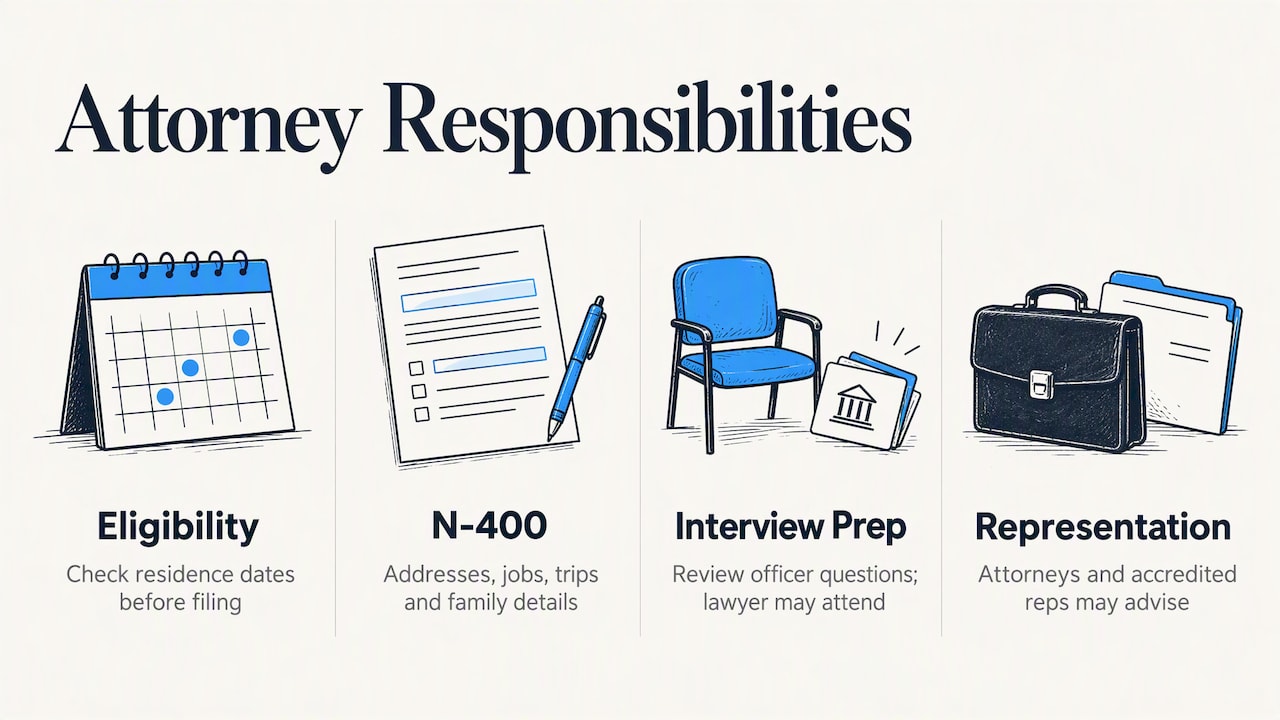
Becoming a citizen is a milestone, and the paperwork behind it is more detailed than most people expect. An attorney’s work usually falls into four parts.
Eligibility review. Before anything is filed, we look at whether you meet the requirements today or whether waiting a few months protects you. USCIS says applicants generally need five years of continuous residence before filing and must meet the physical presence requirement. Some applicants married to a U.S. citizen may qualify on a shorter timeline, and USCIS policy sets out the three-year path for spouses of citizens. Counting the dates correctly is where many self-filed cases go wrong.
Form preparation. The N-400 asks about your addresses, employment, trips, marriages, children, organizations and past encounters with law enforcement. An attorney helps you answer each question accurately and consistently with your earlier immigration records, and tells you which supporting documents to include.
Interview and test preparation. A lawyer can walk you through what the officer may ask about your application, and can attend the interview with you.
Representation. USCIS states that only attorneys and EOIR-accredited representatives can provide legal advice about forms, explain immigration options, or communicate with USCIS about your case. If USCIS asks for more evidence or something unexpected comes up, your lawyer responds for you.
Do You Need a Lawyer for the N-400?
Not always. A straightforward case can be filed by the applicant. A person who has held a green card for many years, never left the country for long, has no arrests and has a clean tax and address history may be comfortable doing it alone.
But “straightforward” is a judgment you can only make with full information, and the form asks for decades of detail. These situations are the ones where we most often recommend legal review before filing:
- Long or frequent trips abroad. The physical presence rule generally means spending at least half of the required period in the United States, and trips longer than 180 days may disrupt continuous residence.
- Any arrest, citation or charge, even if it was dismissed, expunged or happened years ago. The way you disclose it matters. Good moral character is generally assessed over the five years before filing, or three for those married to citizens, and the officer looks at your whole record.
- Earlier immigration problems, such as a prior denial, a removal proceeding, a missed hearing or a green card obtained under unusual circumstances.
- Tax, child support or selective service questions.
- Name changes, marriages or divorces that leave gaps or inconsistencies in your records.
- Medical or disability issues that affect your ability to take the English or civics test.
- Military service, which has its own rules and forms.
If none of these apply and you feel confident, you can file. If even one does, a consultation before you submit is inexpensive protection for a decision that affects your whole family.
The Naturalization Process Step by Step
USCIS describes a 10-step process that runs from learning about citizenship to taking the Oath of Allegiance. In practical terms, it looks like this:
- Confirm eligibility. Review residence, physical presence, age, good moral character and your status history.
- Gather documents. Green card, travel dates, tax records, marriage and divorce records, and any court documents.
- File Form N-400. You may file online or by paper.
- Attend biometrics, if USCIS schedules it.
- Interview. An officer reviews your application under oath and tests your English and civics knowledge.
- Receive a decision. Approval, a request for more evidence, or a denial.
- Take the Oath of Allegiance. You become a citizen at the ceremony.
The civics and English test
The civics portion is oral. For the 2025 version, the officer asks up to 20 questions from a list of 128 and you need 12 correct answers to pass. Which version applies to you depends on when you filed, so confirm it on the USCIS study page before you begin studying. We help clients practice with the right list, and we explain any exceptions that may apply based on age and years as a permanent resident.
What It Costs: USCIS Fees and Attorney Fees
There are two separate costs, and readers often mix them up.
| Cost | Who you pay | Amount |
|---|---|---|
| N-400 filing fee, online | USCIS | $710 |
| N-400 filing fee, paper | USCIS | $760 |
| Legal representation | Your attorney | Set by the firm, based on your case |
Attorney fees vary with the complexity of the case, so a responsible lawyer will give you the fee and what it covers in writing before you commit. Ask whether the fee includes interview preparation and attendance, responses to requests for evidence and any follow-up if something changes. We do not publish a flat price, because a clean file and a file with a prior arrest are different amounts of work. We would rather quote you after we have looked at your situation.
If cost is a barrier, there are options. USCIS links to Department of Justice lists of attorneys offering free or low-cost immigration services, and the DOJ Recognition and Accreditation Program allows nonprofit organizations to authorize representatives. As the American Bar Association explains, recognized organizations must serve low-income clients and have policies allowing fee waivers.
Military Families and Naturalization
Service members and their families can have a different route. According to Military OneSource, eligible service members may have shorter residency requirements and waived application fees, and some may be interviewed and naturalized overseas. Form N-426 is used to certify military service. The same source notes that spouses may naturalize abroad if they are authorized to accompany the service member on official orders and meet specific requirements.
For families near Fort Drum, these rules are not abstract. Timing around deployments, orders and transfers can decide which path makes sense, and we help military families sort through naturalization along with related matters such as Parole in Place.
Preparing Your Documents, Including Translations
Documents in another language need an English translation with a certification that the translator is competent. If you have foreign birth, marriage or divorce records, sort this out early so it does not hold up your filing. For a plain explanation, see who can translate documents for USCIS.
Bring or prepare these for your first meeting with an attorney:
- Your green card and any other immigration documents
- A list of every trip outside the U.S. since you became a permanent resident, with dates
- Addresses and employers for the relevant years
- Marriage certificates, divorce decrees and children’s birth certificates
- Any arrest, court or police records, including dismissals
- Recent tax returns
How to Choose a Naturalization Attorney
A good choice comes down to a few checks.
Confirm the license. USCIS advises you to check an attorney’s current license with the state agency where they are licensed. Avoid anyone who is not an attorney or accredited representative but offers to advise you on your case, since USCIS reserves that role to those two groups.
Look for focus. Immigration law is its own field. Ask how much of the practice is immigration and how often the lawyer handles N-400 cases.
Ask who you will talk to. In many offices you meet the attorney once and then deal with staff. Ask who answers your questions and who attends your interview.
Get the scope and fee in writing. You should know what is included before you pay.
Check the language fit. It is easier to share a complicated history in the language you are most comfortable in.
Prefer local knowledge. The USCIS field office handling your case, the local interview process and the courts in your area all affect how your case moves.
Our Perspective
After nearly 30 years in Central New York, we have seen that most naturalization problems are decided long before the interview, at the moment someone fills in a form without knowing what it means for the rest of their record. A missed trip, an old citation, a date typed from memory: none of these feels like a big deal to the applicant, and each can raise questions with an officer.
That is why we handle every naturalization case personally and directly. You speak with the attorney who reviews your file, in English or Spanish, and we tell you plainly whether you are ready to apply or whether it is wiser to wait. Our goal is to make the pathway to citizenship clear, so that when you stand at the Oath ceremony, you already know the work was done right.
Craig Nichols
Work With Nichols Law Offices on Your Citizenship Application
If you live in Syracuse, Rome, Utica, Binghamton, Onondaga County, Jefferson County or around Fort Drum, we can review your eligibility, prepare your N-400 and guide you through the interview. Craig K. Nichols works directly with each client, and we offer support in English and Spanish.
Learn more about our naturalization services, or read our guide to becoming a citizen through naturalization in Syracuse. If you are still a permanent resident working toward eligibility, our page on becoming a permanent resident is a good place to start.
Frequently Asked Questions
Do I need a lawyer to file for U.S. citizenship?
No. USCIS says you can file Form N-400 yourself, including online. Many applicants choose an attorney when their case has complications such as criminal history, long trips abroad or prior immigration problems, because a lawyer can advise on forms and speak with USCIS for you.
When is the best time to talk to a naturalization attorney?
Before you file. A review at that stage can show whether you meet the residence and presence requirements and whether anything in your record needs explanation. It is much harder to fix a problem after an application is submitted or denied.
Is the attorney fee the same as the USCIS fee?
No. The USCIS filing fee, currently listed at $710 online and $760 on paper, goes to the government. Legal fees are separate and depend on the work your case needs. Ask for the scope and the fee in writing.
Can military families get help with naturalization?
Yes. Eligible service members may have shorter residency requirements and waived fees, and some can naturalize overseas. Spouses may also qualify to naturalize abroad in certain circumstances. An attorney can confirm which rules apply to your service and your family.
Sources
- Commonly Asked Questions About the Naturalization Process, USCIS
- 10 Steps to Naturalization, USCIS
- Application for Naturalization (N-400), USCIS
- Legal Services, USCIS
- Study for the Test, USCIS
- Spouses of U.S. Citizens Residing in the United States, USCIS Policy Manual
- Avoiding the Unauthorized Practice of Immigration Law, American Bar Association
- Military Citizenship & Immigration Services, Military OneSource
- USCIS Expands Good Moral Character Standards for Naturalization, Hunton
- Who Can Translate Documents for USCIS
Recommended
- Naturalization Lawyer in Syracuse, NY: Your Path to U.S. Citizenship
- Becoming a Permanent Resident in the United States: Your Guide from a Syracuse Immigration Attorney
- Your Trusted Partner: Why Choose a Local Immigration Attorney in Syracuse, NY
- How to Become a U.S. Citizen Through Naturalization in Syracuse, NY: A Complete 2026 Guide