

To sponsor a relative for a green card, your household income generally has to reach at least 125% of the federal poverty guideline for your household size. You prove it on Form I-864, the Affidavit of Support. If you want to bring a parent to the United States, you must also be a U.S. citizen who is at least 21 years old. If your income falls short, you still have options, including a joint sponsor, income from household members, or qualifying assets. This guide explains each one in plain terms, so you can see where you stand before you file anything.
Key Takeaways
- Most sponsors must show household income at or above 125% of the federal poverty guideline for their household size, as USCIS explains in its Affidavit of Support guidance.
- Only a U.S. citizen who is 21 or older can petition for a parent. A green card holder cannot.
- Household size counts you, your dependents, anyone you sponsored before, and the new immigrants. Adding a second parent raises the number you must meet.
- If your income is too low, a joint sponsor, a household member’s income (Form I-864A) or assets can close the gap.
- The poverty guidelines change every year, so check the current USCIS chart before you file.
Table of Contents
- Who can sponsor a parent for a green card
- What the Affidavit of Support (Form I-864) is
- The 125% rule: how much income you need
- How household size is counted
- Which income counts, and what proof you need
- If your income is too low: three ways to close the gap
- Mistakes that slow parent sponsorship cases
- Perspective: why the income question deserves a careful look
- When an immigration attorney helps with parent sponsorship
- How we can help you sponsor a parent
- A short checklist before you file
- FAQ
- Sources
Who can sponsor a parent for a green card
The first question is not about money. It is about status. A U.S. citizen who is at least 21 years old can sponsor a parent by filing Form I-130, according to USCIS guidance on bringing parents to live in the United States. Lawful permanent residents cannot petition to bring parents to live permanently in the country, as the same USCIS page states.
If you are a green card holder and your parents are overseas, the practical path often runs through naturalization first. Once you become a citizen and are 21 or older, you become eligible to petition. Our naturalization practice helps clients who are working toward that milestone.
After the petition is approved, the process splits in two directions:
- Your parent lives abroad. They complete visa processing at the local U.S. consulate.
- Your parent is in the United States. They may be eligible to file Form I-485 at the same time as the petition, which is called concurrent filing. Eligibility depends on how they entered and their current status, so this is a point to review with an attorney before anyone files.
The income requirement comes into the picture at the green card stage, when the Affidavit of Support is submitted alongside the case.
What the Affidavit of Support (Form I-864) is
Form I-864 is a financial promise. USCIS says that by signing it, the sponsor enters a contract to use their resources to support the intending immigrant if necessary, per the Form I-864 instructions. It is not a formality. It is a legal commitment that can remain in force long after the green card arrives.
USCIS also published a new edition of Form I-864 on August 31, 2026, with a 30-day grace period for the previous version, according to the alert on the Form I-864 page. Because forms change, always download the current edition from USCIS before you start. Using an outdated edition is one of the simplest ways to lose weeks on a case.
The 125% rule: how much income you need
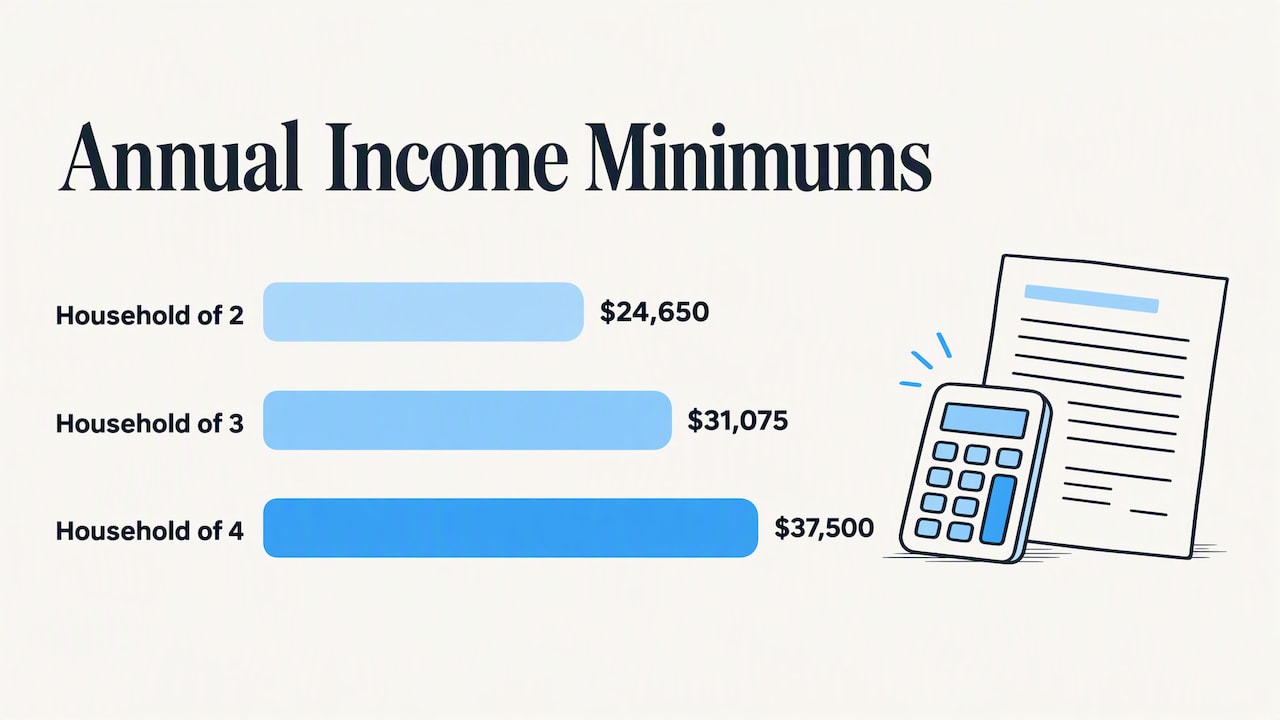
USCIS states that a sponsor must show household income equal to or higher than 125% of the federal poverty level for their household size, as described in its Affidavit of Support overview. The figures are published each year on Form I-864P, and the current numbers took effect on March 1, 2026.
For sponsors who are not on active duty, the I-864P lists these 125% minimums:
| Household size | Minimum annual income (125% of poverty guideline) |
|---|---|
| 2 | $24,650 |
| 3 | $31,075 |
| 4 | $37,500 |
Per the USCIS Form I-864P chart, the guideline adds $6,425 for each person beyond a household size of eight. The chart also covers sizes five through eight. Look up your own row there, because some websites publish different numbers, sometimes from another year or for a different state group. The official chart is the one USCIS officers use.
Military sponsors
If you are on active duty in the U.S. armed forces and petitioning for a spouse or child, you only need to meet 100% of the poverty guideline for your household size, USCIS notes in the same Affidavit of Support guidance. That reduced threshold does not apply to a parent petition, so a service member sponsoring a mother or father generally works from the 125% figure. Military families near Fort Drum often have other pathways to review as well, such as Parole in Place for military families.
How household size is counted
Household size is where many families miscalculate. According to the Form I-864 instructions, it includes:
- You, the sponsor.
- Your dependents, such as children and anyone you claim on your taxes.
- Any immigrants you previously sponsored whose obligations have not ended.
- The new immigrants you are sponsoring now.
That last item matters when you bring both parents. A citizen who is married with two children and sponsors one parent has a household of five. Sponsor both parents and it becomes six, which raises the required income. You can see the effect on the chart: each added person raises the threshold.
A worked example, using the I-864P figures above: you are a single citizen with no dependents, sponsoring one parent. Your household is two, and the 125% minimum is $24,650. If you are married with one child and you sponsor one parent, your household is four, and the minimum is $37,500. The same sponsor adding the second parent makes five, so you would look up the size-five row on the chart.
Which income counts, and what proof you need
USCIS asks for an IRS tax transcript or a copy of your federal income tax return for the most recent tax year, as laid out in the Form I-864 instructions. Your current income is what counts toward the requirement, so recent pay stubs and an employer letter are common supporting items, since your last tax return may not reflect a raise or a new job.
Two other sources of income can be counted:
- Household members. Income from relatives living with you can count if they are listed as dependents on your most recent federal tax return, or have lived with you for the last six months, and they sign Form I-864A. The instructions say so directly.
- The immigrant’s own income. Under certain conditions, income from the intending immigrant can be counted. This often applies when a parent already lives in your home and works. The conditions are specific, so confirm them in the instructions before you rely on it.
Families in Central New York often live in multigenerational homes, so this rule can matter more than people expect. A sibling who shares the household and has steady income may be the difference between filing smoothly and needing a joint sponsor.
If your income is too low: three ways to close the gap
A shortfall does not end the case. The Form I-864 instructions describe three routes, and you can sometimes combine them.
Use a household member’s income
As above, a qualifying relative signs Form I-864A and accepts financial responsibility for the sponsored immigrant for the duration of the obligation. Their income is added to yours for the calculation.
Use assets
Assets must be convertible to cash within one year. The instructions state that their total value must generally equal five times the difference between your household income and the poverty guideline. The multiple drops to three for a U.S. citizen sponsoring a spouse or a child aged 18 or older. A parent is not in that group, so the five-times rule is the one that applies to most parent cases.
Here is an illustration with made-up numbers. Suppose your household of four needs $37,500 and earns $33,500. The gap is $4,000. Five times that is $20,000, which is the asset value you would need to show. Savings, certificates of deposit and similar liquid holdings can qualify, but the instructions govern what exactly is counted, so review them before you gather statements.
Add a joint sponsor
A joint sponsor is a separate person who meets the income requirement on their own. USCIS emphasizes that a joint sponsor is not merely a substitute. They are an additional party who takes on legal liability alongside you for the immigrant’s support, according to the Affidavit of Support guidance. Choose someone who understands what they are signing, because the promise is real.
| Option | Who signs | Best fit |
|---|---|---|
| Household member income | Relative in your home, on Form I-864A | A working relative who lives with you |
| Assets | You | Savings or liquid holdings that cover five times the gap |
| Joint sponsor | A separate person who meets 125% alone | No other route covers the shortfall |
Mistakes that slow parent sponsorship cases
Most delays trace back to a short list of avoidable errors:
- Wrong household size. Forgetting a previously sponsored immigrant, or a second parent, puts you on the wrong row of the chart.
- Outdated form edition or chart. Both change, as the new edition alert shows.
- Missing tax documents. The most recent tax year’s return or transcript is expected.
- Assuming a green card holder can petition. Lawful permanent residents cannot, as covered at the top of this guide.
- Treating the joint sponsor as a favor. It is a legal contract, and the person signing needs the full picture.
Perspective: why the income question deserves a careful look
We meet many families who delay a parent’s petition for years because they assume they do not earn enough. Often the assumption is wrong. When household size is counted correctly and every qualifying source of income is considered, the numbers look different than families expected.
Sometimes the opposite happens. A client believes they clearly qualify, then learns a previously sponsored relative changes the household count. Either way, we believe the right time to run the numbers is before filing, with someone who has done it hundreds of times.
With nearly 30 years of practice in Central New York, we handle each case personally. You speak with your attorney directly, in English or Spanish, and you get an honest assessment of your options, including whether a joint sponsor or a household member’s income makes sense for your family. A well-prepared affidavit is a lifeline for a case. It can mean the difference between a smooth approval and months of correspondence.
Craig Nichols
When an immigration attorney helps with parent sponsorship
Many straightforward cases can be assembled by a careful family. A lawyer becomes valuable when something in the file does not fit the standard picture. These are the situations we see most often:
- Your income is close to the line, and you are deciding between a joint sponsor, household income and assets.
- Your parent is already in the United States and you are weighing concurrent filing against consular processing. How your parent entered the country can change the answer.
- Your parent has a past immigration violation, overstay, or criminal record that may call for a waiver.
- You are a green card holder and want to know the fastest legal route to citizenship, so you can petition later.
- You have sponsored someone before and are not sure whether that obligation still counts in your household.
- Your family includes a member who may qualify under a different category, such as a service member’s relative.
Our family immigration guide for Syracuse covers the wider process, and you can read about adjustment of status without leaving the U.S. if your parent is already here.
How we can help you sponsor a parent
Nichols Law Offices, PLLC represents families in Syracuse, Rome, Utica, Binghamton and around Fort Drum. We handle green card applications, family reunification, adjustment of status, naturalization and related matters, with bilingual English and Spanish support. When you work with us, you deal directly with attorney Craig Nichols, not a rotating team.
For a parent petition, that means reviewing your status, counting your household, checking your income against the current chart, and choosing the strongest way to meet the requirement before anything is submitted. Learn more on our family immigration page, or reach out through our main site to discuss your situation.
If your parent’s case also involves a green card application inside the U.S., our green card services page explains how we approach it.
A short checklist before you file
- Confirm you are a U.S. citizen aged 21 or older.
- Count your household using the four groups listed above.
- Find that household size on the current Form I-864P chart.
- Compare it against your current income and your latest tax return.
- If you fall short, evaluate household income, assets and a joint sponsor.
- Download the current edition of Form I-864 from USCIS.
- Gather tax transcripts, pay records and identity documents for everyone who signs.
FAQ
Can a green card holder sponsor their parents?
No. According to USCIS, lawful permanent residents cannot petition to bring parents to live permanently in the United States. A U.S. citizen who is at least 21 years old can. Many green card holders become eligible to petition after they naturalize.
How much money do I need to sponsor my mother or father?
For most sponsors, household income must be at least 125% of the federal poverty guideline for your household size. Under the 2026 USCIS chart, that is $24,650 for a household of two, $31,075 for three and $37,500 for four. Confirm your own size on Form I-864P before filing.
Can I use someone else’s income if mine is too low?
Yes. A relative in your household can add income by signing Form I-864A, provided they meet the dependent or six-month residence rule. You can also use qualifying assets, or add a joint sponsor who meets the requirement independently. Each route carries legal responsibility for the sponsored immigrant.
Does the income requirement change every year?
Yes. USCIS updates the poverty guideline chart annually, and the current figures took effect March 1, 2026. The form itself was also reissued in a new edition on August 31, 2026. Always use the latest versions from USCIS when you prepare your case.
Do I need a lawyer to sponsor my parents?
Not every case requires one, but an attorney is worth consulting if your income is near the minimum, your parent is already in the U.S., or there is any past immigration issue. A review before filing is usually far easier than correcting a problem afterward.
Sources
- Bringing Parents to Live in the United States as Permanent Residents (USCIS)
- Affidavit of Support (USCIS)
- HHS Poverty Guidelines for Affidavit of Support, Form I-864P (USCIS)
- Form I-864 Instructions for Affidavit of Support (USCIS)
- Affidavit of Support Under Section 213A of the INA, Form I-864 (USCIS)
Recommended
- Family Immigration in Syracuse, NY: Your Complete Guide to Sponsoring a Loved One for a Green Card
- Adjustment of Status in Syracuse, NY: How to Get a Green Card Without Leaving the U.S. (2026 Guide)
- Becoming a Permanent Resident in the United States: Your Guide from a Syracuse Immigration Attorney
- How to Get an Immigrant Visa (Green Card) in Syracuse, NY: Complete 2026 Guide