

A military immigration lawyer helps service members, veterans and their relatives use the special rules Congress and the executive branch created for military families: citizenship through service, parole in place for relatives who entered without inspection, expedited naturalization for spouses, and green cards that follow from them. If someone you love is serving, or has served, and a family member’s status is uncertain, the right attorney can show you which pathway fits your facts and handle the filings from start to finish. At Nichols Law Offices, PLLC, we represent military families across Central New York, including the Fort Drum community, and we offer bilingual support in English and Spanish.
Key Takeaways
- Honorably serving service members and veterans may apply for citizenship under INA § 328 or § 329 with no application fees, and the rules differ for peacetime and wartime service.
- Parole in place (PIP) can be granted case by case to certain relatives of current or former service members who are in the U.S. without having been admitted, and for many it opens the door to a green card.
- Spouses of service members stationed abroad may qualify for faster naturalization, and some can naturalize overseas.
- Every case turns on individual facts: how a relative entered, family relationship, service record and discharge status all matter.
- Before you hire anyone, confirm that the person is a licensed attorney in good standing. Only licensed lawyers and accredited representatives can represent you in immigration court.
Table of Contents
- What a military immigration lawyer actually does
- Citizenship through military service
- Parole in place for military families
- Options for military spouses
- Military legal assistance and when to bring in a private attorney
- Finding the right lawyer: credentials, language and fit
- When the situation is urgent
- How we can help your family
- FAQ
- Sources
What a military immigration lawyer actually does
Military immigration is not a separate body of law so much as a set of exceptions and discretionary programs layered on top of ordinary immigration law. A lawyer who works in this area does four things for you.
First, we identify the right pathway. A soldier with a green card, a veteran with an undocumented parent and a spouse who came on a visa and stayed past its expiration all have very different options, even though each is part of a military family.
Second, we build the evidence. Military cases rest on paperwork that only the military can produce, such as certified service records, discharge documents and proof of the family relationship. Getting it organized correctly the first time prevents delays.
Third, we file and follow the case. That means the applications, the correspondence with USCIS, the interview preparation and, when needed, representation if a case becomes complicated.
Fourth, we protect the family from avoidable mistakes. A well-meant filing in the wrong category, or a trip abroad at the wrong moment, can create problems that are harder to solve than the original one.
Our military personnel page outlines how we approach these matters for families in our region.
Citizenship through military service
If you are a service member or veteran who is not yet a citizen, the law gives you a faster and cheaper route than most applicants have. USCIS explains that honorably serving members and veterans may apply under INA § 328 or § 329 by filing Form N-400, and that there are no fees for these applications.
Peacetime service (INA § 328)
Under § 328, you generally need at least one year of honorable service, lawful permanent resident status at the time of your interview, English and civics knowledge, attachment to the principles of the Constitution, and good moral character from five years before filing through naturalization. Residence and physical presence requirements are relaxed for qualifying service members. These are the eligibility requirements USCIS lists for this category.
The one-year service requirement is itself a product of change: the USCIS Policy Manual notes that 2003 reforms cut the peacetime requirement from three years to one, waived fees and allowed processing at embassies, consulates and military bases overseas.
Wartime service (INA § 329)
Under § 329, qualifying service during a period designated as one of hostilities removes the continuous-residence and physical-presence requirements. Applicants must have been lawful permanent residents or been physically present in a specified qualifying location when they enlisted, reenlisted, extended service or were inducted, according to USCIS. The Army’s fact sheet on military naturalization adds that service members who serve during designated hostilities may not need to be permanent residents at all.
The paperwork in practice
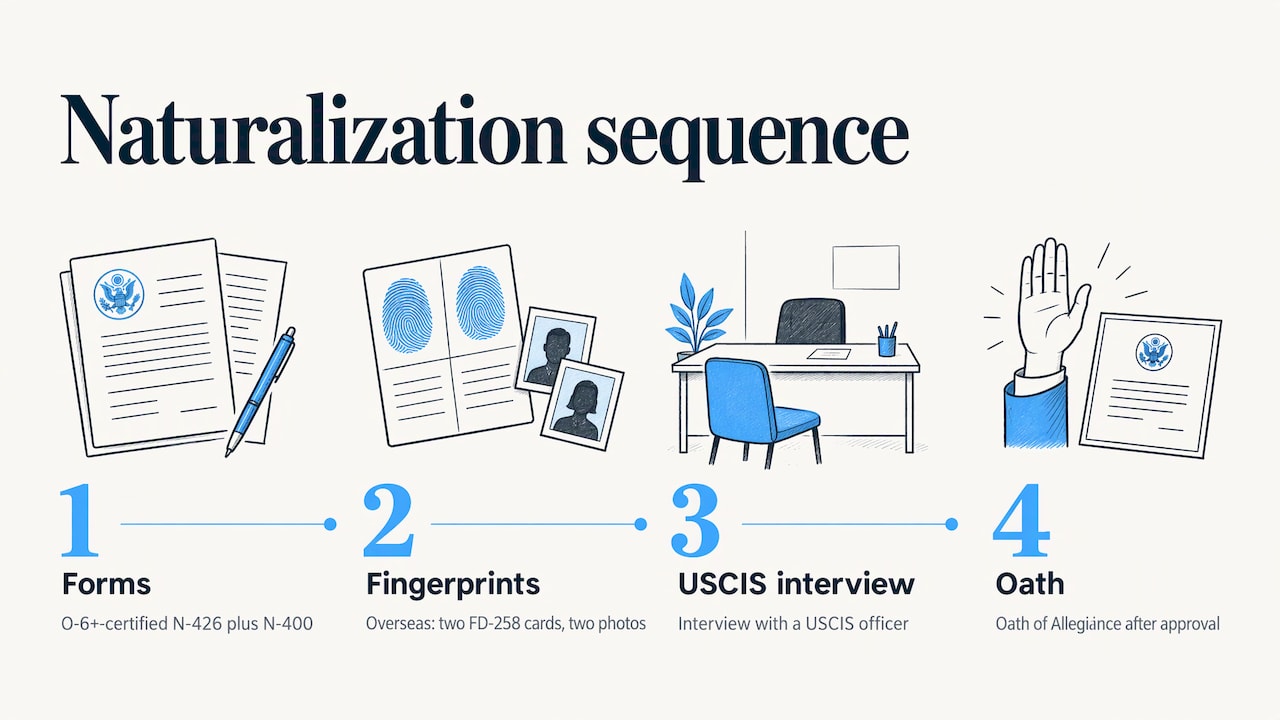
Military OneSource describes the usual sequence: Form N-426, certified by the chain of command at the O-6 level or above, plus Form N-400; fingerprints (and, overseas, two FD-258 cards and two passport photos); an interview with a USCIS officer; and, once approved, the Oath of Allegiance. The full list is in the Military OneSource citizenship guide.
Good moral character is the part of the file that deserves the most care. An old arrest, a discharge characterization that is not fully honorable, or an inconsistency between forms can derail an otherwise strong case. If anything in your record gives you pause, speak with an attorney before you file, not after. Our naturalization services cover this stage of the journey.
Parole in place for military families
For many families, parole in place is the lifeline. It is meant for relatives of current or former service members who are living in the United States without having been admitted or paroled.
USCIS states that PIP is granted case by case, in one-year increments, to qualifying relatives of current or former members of the armed forces. It is discretionary, which means a grant is never automatic, and the quality of your evidence and the story it tells both count.
Why PIP matters for a green card
The Army’s Judge Advocate information paper on military PIP explains the key effect: a grant of parole satisfies the “inspected and paroled” requirement of INA § 245(a), so many relatives can complete adjustment of status entirely inside the United States instead of leaving for a consular interview.
The same paper is careful about the limits, and so should you be. PIP does not erase unlawful status. Under INA § 245©(2), people in unlawful status are generally barred from adjusting unless they are immediate relatives of a U.S. citizen: a spouse, an unmarried child under 21, or a parent. So the next step depends on who sponsors whom. A spouse of a citizen soldier is in a very different position from a sibling or an adult child.
What the PIP request includes
According to Military OneSource, a request includes a completed Form I-131 with “Military PIP” written in Part 2, proof of the family relationship (such as a marriage certificate, birth certificates or DEERS enrollment), proof of the service member’s or veteran’s status (a military ID or DD Form 214), two passport-style photographs, and evidence of any other favorable discretionary factors. The list appears in the Military OneSource guide.
That last item, favorable factors, is where legal judgment earns its keep. Length of residence, family ties, community involvement and the service member’s record all help show why discretion should be exercised in your favor.
We explain this program in more depth on our Parole in Place page and in our guide to PIP and green cards.
If a relative was admitted but overstayed
PIP is not available to someone who was lawfully admitted and then overstayed. USCIS says those relatives may qualify for deferred action for up to two years instead. The underlying policy memorandum, PM-602-0114, treats being the spouse, parent, son or daughter of a qualifying service member as a particularly strong positive factor.
The Congressional Research Service gives a plain-language overview of how these discretionary options fit together for military family members who may be removable.
Relatives outside the country
The Immigrant Military Members and Veterans Initiative allows DHS to consider parole requests from certain current and former service members and qualifying family members who are outside the United States and want to come in to use U.S. legal counsel and systems and to access certain veterans’ benefits. USCIS describes how these requests are handled, including expedited processing, on the discretionary options page.
Options for military spouses
If your spouse is a U.S. citizen serving in the armed forces and you are a lawful permanent resident, your path to citizenship may be shorter than the ordinary one.
USCIS says spouses of citizen service members who are or will be stationed abroad for at least one year may be eligible for expedited naturalization under INA § 319(b). Generally you must be 18 or older, a permanent resident present in the U.S. at your interview and oath, authorized to accompany your spouse abroad, and able to meet the English, civics and other requirements.
If you are already overseas with your spouse, there is another route. Under INA § 319(e)(2) and 8 U.S.C. § 1443a, a permanent resident married to a service member can naturalize abroad, without traveling home, if official orders authorize you to accompany the service member and you meet the other conditions, as USCIS explains.
An Army info paper on naturalization for military spouses compares the three spouse pathways side by side:
| Pathway | Who it fits | Time requirements in brief |
|---|---|---|
| INA § 316(a) | Permanent residents of five years | 2.5 years of continuous presence |
| INA § 319(a) | Married to a U.S. citizen for three years and a permanent resident for three years | 18 months of continuous presence |
| INA § 319(b) | Spouses of citizen service members on accompanied overseas orders of more than one year | Immediate application |
The same paper notes that time spent outside the U.S. on accompanied military orders counts toward continuous presence. That detail changes the math for many families who have moved from base to base, which is why we recommend running the dates with an attorney before concluding you are not yet eligible.
Spouses who are not yet permanent residents usually begin with a green card. Our pages on green cards and adjustment of status and the adjustment of status guide walk through that first step. Engaged to a service member? Our fiancé visa page covers the K-1 process.
Military legal assistance and when to bring in a private attorney
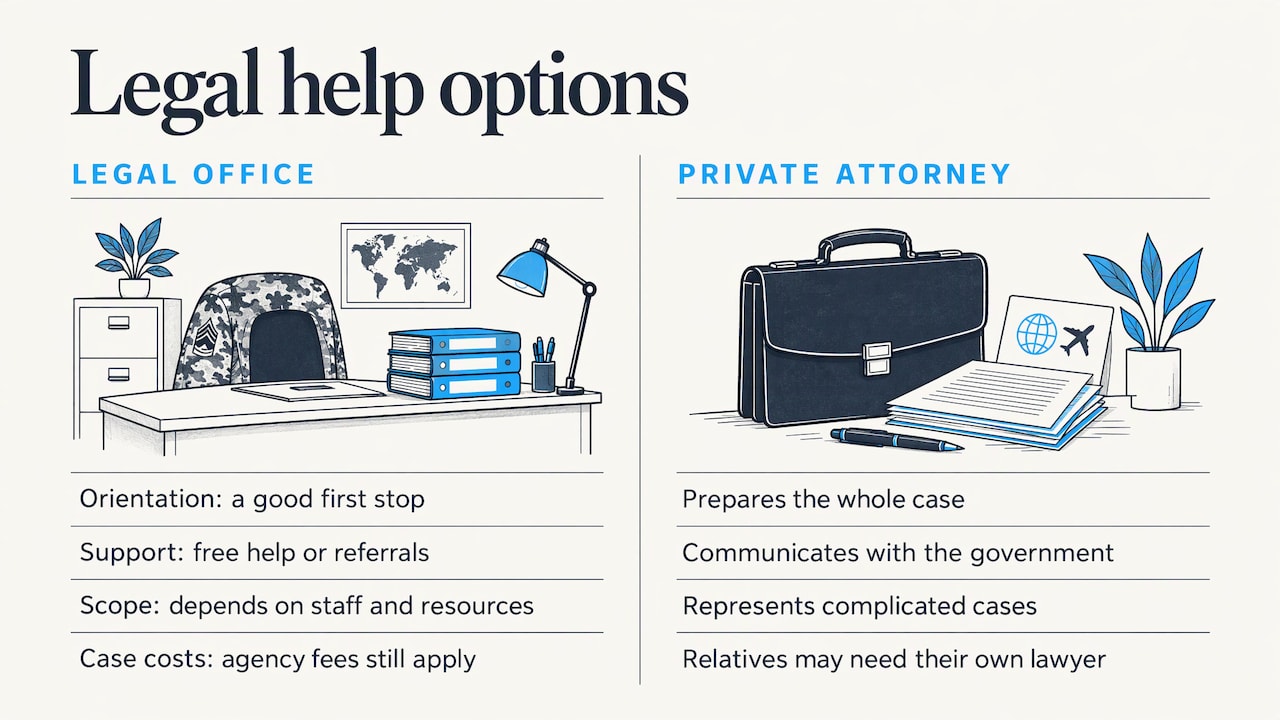
Military families have resources of their own, and it is worth knowing how to use them. Military OneSource says a legal assistance office provides free legal support or referrals on immigration, citizenship and naturalization, including fiancé visas, reentry permits and the citizenship of children born abroad to military parents.
The Air Force Legal Assistance System explains that these offices can normally help with immigration and naturalization, depending on staff, resources and expertise. It also says that eligible clients still pay case costs such as agency fees, and that advice generally is not given by phone or email. Those details are in its FAQ.
That arrangement is why the military itself reaches out to immigration practitioners. The AILA Military Assistance Program, set up in 2008, pairs the American Immigration Lawyers Association with JAG legal assistance offices so that complex questions reach experienced immigration counsel.
In practice, a legal assistance office is a good first stop for orientation. When your family needs a lawyer to prepare the whole case, communicate with the government, and stand with you through a long process, that is where a private immigration attorney comes in. Relatives of a service member are often not eligible for the same office, either, so the family member who needs status frequently needs a lawyer of their own.
Finding the right lawyer: credentials, language and fit
Immigration fraud preys on families who are worried and in a hurry. A few checks protect you.
- Confirm the license. The ICE handout “Role of a Lawyer” says only licensed lawyers and Department of Justice accredited representatives can give legal advice and represent people in immigration court. It advises you to ask which state the attorney is licensed in and for a bar number, then check the state bar or supreme court website to confirm the lawyer is active and in good standing.
- Be cautious with notarios and consultants. The same handout warns that people who call themselves notarios, visa consultants or immigration consultants are generally not lawyers and cannot represent you in immigration court. The exception is Puerto Rico, where notarios are lawyers.
- Understand when representation begins. According to the handout, a lawyer is not officially your representative until both of you sign a contract, usually called a retainer agreement. The first meeting may be an intake or consultation.
- Expect honesty. A lawyer cannot lie to the government or the court for you.
For Spanish speakers, language is part of the quality of the representation. You should be able to ask questions, read your engagement agreement and understand every form you sign in the language you are most comfortable with. At our office you speak directly with Craig Nichols, and we support clients in both English and Spanish, so nothing important is lost in translation.
What to bring to your first meeting
The ICE handout suggests bringing all your immigration documents in an organized folder. For a military family case, we would add:
- Your passport and any visas, I-94 records or notices received from USCIS or immigration court.
- Proof of the relationship: marriage certificate, birth certificates, DEERS enrollment.
- The service member’s or veteran’s military ID, DD Form 214 or other service records.
- A timeline of entries into the U.S., addresses and any trips abroad.
- Any arrest or court records, even if you think they are minor or old.
Do not hold back because a document is missing. Part of our job is helping you obtain what you need.
When the situation is urgent
Some military families come to us under pressure: a relative has received a notice to appear, a deployment is approaching, or a service member is worried about a spouse’s status. In those moments, speed matters, but so does accuracy. Our firm also handles deportation defense, humanitarian relief and waiver applications, so if a PIP request or a green card case is complicated by a past problem, we can look at the whole picture rather than a single form.
Our perspective on military immigration cases
In nearly three decades of practice in Central New York, we have seen what uncertainty does to a military household. A soldier can be fully committed to the mission and still lie awake wondering whether a spouse or a parent could be taken away. Programs like parole in place exist because the government recognizes that burden.
We believe those programs work best when a family is represented by someone who knows the file as well as they do. That is why you work directly with Craig Nichols, not a rotating cast of staff. We look at how each relative entered, what the service record shows, and which route leads to a green card or citizenship with the fewest surprises.
Our work is built on clarity. We explain, in English or Spanish, what a filing can and cannot do, what evidence will carry weight, and what comes next. Military families have already given a great deal. Our role is to give you trusted guidance for the legal side of your journey and to help you build a future here with confidence.
Craig Nichols
How we can help your family
Nichols Law Offices, PLLC represents individuals and families in Syracuse, Rome, Utica, Binghamton and the Fort Drum area. For military families, that includes parole in place, adjustment of status, naturalization, family-based green cards and fiancé visas, along with deportation defense when a case becomes more serious.
If you are ready to talk through your situation, start with our Parole in Place and military family services and tell us who is serving, who needs status and what has already been filed.
You can also read about our approach to family immigration, or browse our blog for more guides.
FAQ
Can an undocumented spouse or parent of a service member get a green card?
Often there is a path, but it depends on how the relative entered and who the petitioner is. Parole in place can resolve the “inspected and paroled” problem, and spouses, parents and unmarried children under 21 of U.S. citizens are immediate relatives who may then adjust status. Other relatives face additional hurdles, so an individual review is essential.
Do service members pay to apply for citizenship?
No. USCIS states that honorably serving service members and veterans who apply under INA § 328 or § 329 pay no application fees. An attorney’s fees for representation are separate, and we are happy to explain them before you sign anything.
Do I need a lawyer if I have access to military legal assistance?
Legal assistance offices can orient you and make referrals, and they are limited by staff, resources and expertise. For a full representation, especially if a relative has no lawful status or a past record to address, many families choose a private immigration attorney to prepare, file and follow the case.
Can I find a bilingual immigration attorney near Fort Drum?
Yes. We serve Jefferson County and the rest of Central New York in English and Spanish, and you speak directly with Craig Nichols. Whatever attorney you choose, verify the license and good standing with the state bar, as the ICE handout recommends.
What should I do if a relative has received a court notice?
Gather the notice and every document you have, and speak with an immigration attorney right away. Deadlines in immigration court are strict, and the options available to a military family member, including deferred action or other relief, depend on the details of the case.
Sources
- Naturalization Through Military Service, USCIS
- Chapter 1, Purpose and Background, USCIS Policy Manual
- Military Naturalization Fact Sheet, U.S. Army
- Military Citizenship & Immigration Services, Military OneSource
- Discretionary Options for Military Members, Enlistees and Their Families, USCIS
- Military Parole in Place info paper, U.S. Army SJA
- Policy Memorandum PM-602-0114, USCIS
- U.S. Citizenship Through Military Service and Options for Family Members, Congress.gov CRS
- Citizenship for Military Family Members, USCIS
- Naturalization for Military Spouses, Army info paper
- AFLASS Frequently Asked Questions, Air Force Legal Assistance
- AILA Military Assistance Program
- Role of a Lawyer, ICE handout