
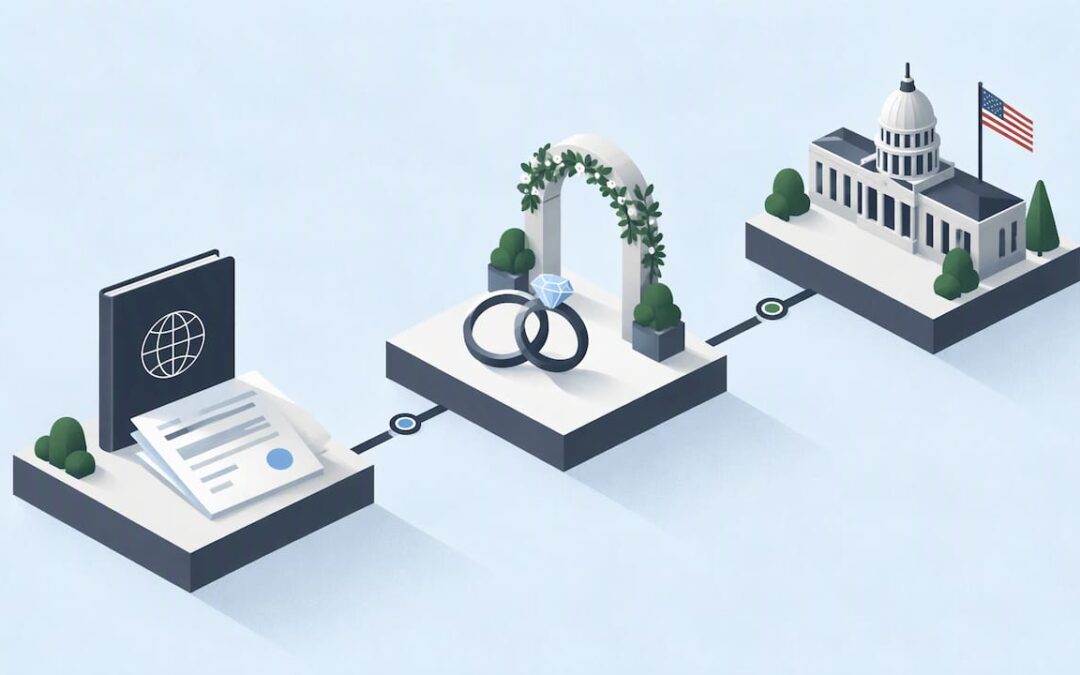
If your fiancé(e) lives abroad and you are a U.S. citizen, the K-1 visa is the pathway that lets them enter the United States to marry you. A fiancé visa lawyer prepares and files the petition, builds the evidence of your relationship, helps you avoid the mistakes that cause delays or denials, and guides you through the consular interview and the green card that follows. This guide explains each stage in plain terms, shows where couples most often run into trouble, and tells you when it makes sense to bring in an attorney.
Key Takeaways
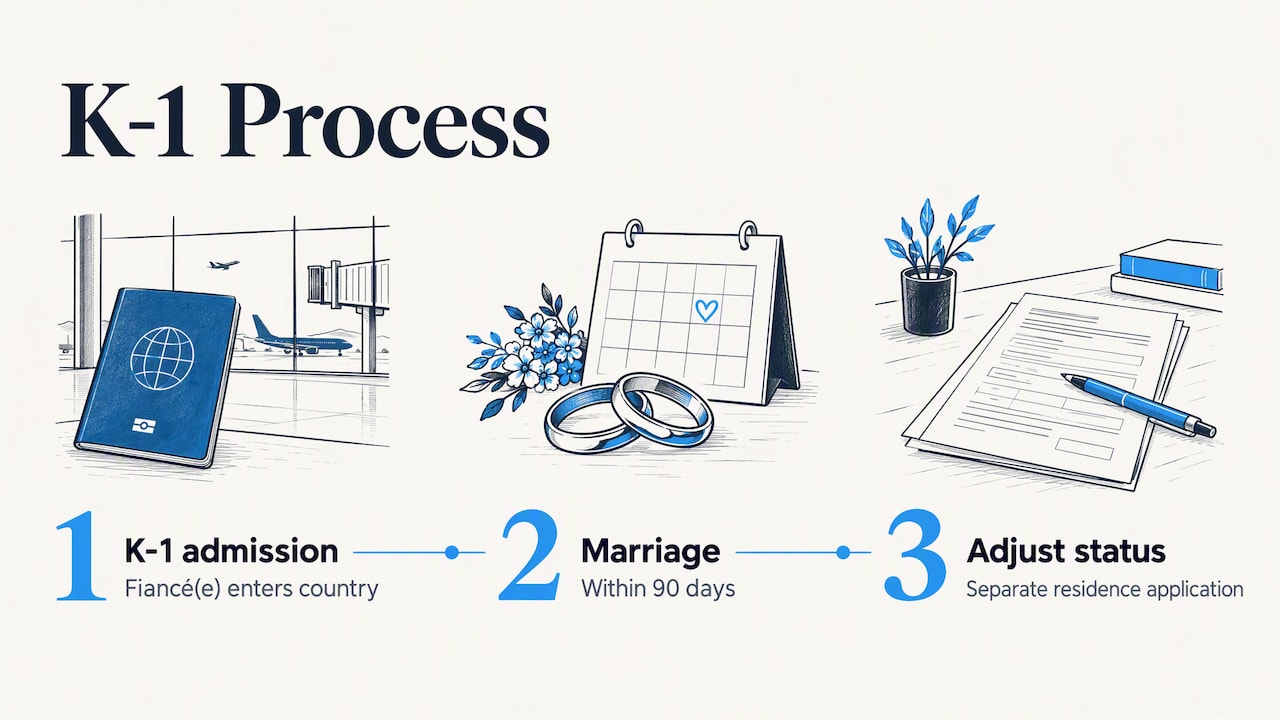
- The K-1 process has three stages: a petition with USCIS (Form I-129F), visa processing through the National Visa Center and a U.S. consulate, and then marriage within 90 days of arrival.
- You must be a U.S. citizen, both of you must be legally free to marry, and you must have met in person within the two years before filing, unless a hardship or cultural exception applies.
- Entering on a K-1 does not make your fiancé(e) a permanent resident. After the wedding, you still file for adjustment of status.
- Only a licensed attorney or a Department of Justice accredited representative may lawfully give immigration advice, so check credentials before you pay anyone.
- Most K-1 problems come from thin or inconsistent evidence, unreported history, or missed requirements, which are exactly the things a lawyer reviews before you file.
Table of Contents
- What a K-1 Fiancé Visa Is, and Who Qualifies
- The K-1 Process Step by Step
- How Long the K-1 Process Takes
- Forms, Documents and Translations
- The Consular Interview
- Common Problems That Delay or Sink a K-1 Petition
- When to Hire a Fiancé Visa Lawyer
- A Note on K-3 Visas
- Our Perspective: Why Details Decide K-1 Cases
- Work With a Syracuse Fiancé Visa Lawyer
- FAQ
- Sources
What a K-1 Fiancé Visa Is, and Who Qualifies
The K-1 is a nonimmigrant visa for the foreign fiancé(e) of a U.S. citizen. Only citizens can petition. A green card holder cannot file for a fiancé(e) on a K-1, which surprises many couples.
According to USCIS, you qualify if you and your fiancé(e) are legally free to marry and intend to marry within 90 days of your fiancé(e)’s admission to the United States. You also must have met in person at least once during the two years before you file. That requirement can be waived only if meeting would cause extreme hardship or would violate strict and long-established cultural or social customs of your fiancé(e)’s family or culture.
“Legally free to marry” means any earlier marriages, for either of you, have ended by divorce, annulment or death. If a prior divorce decree is missing, unclear or issued abroad, sort that out before filing. It is one of the most common reasons a petition stalls.
What counts as meeting in person
The requirement is a real, in-person meeting, not video calls. Couples who met online often need to document a trip: passports with entry and exit stamps, boarding passes, hotel receipts and photographs together. Keep these as you go, because assembling them after the fact is harder than it sounds.
The K-1 Process Step by Step
The State Department describes the sequence this way, and it is the backbone of every K-1 case.
- You file Form I-129F with USCIS. This is the Petition for Alien Fiancé(e). It asks you to prove your citizenship, your eligibility to marry and the genuine nature of the relationship.
- USCIS reviews the petition. It may issue a request for evidence if something is missing or unclear. Answering fully and on time matters.
- The approved petition moves to the National Visa Center (NVC) and then to the U.S. consulate serving your fiancé(e)’s home area.
- Your fiancé(e) applies for the visa. This means completing Form DS-160, gathering civil documents, getting a medical exam and attending a consular interview.
- The visa is issued and your fiancé(e) travels to the United States.
- You marry within 90 days of arrival.
- Your spouse applies for adjustment of status to become a lawful permanent resident.
The K-1 permits a single entry, and the visa is valid for a maximum of six months from issuance, per the same State Department page. If your fiancé(e) does not enter in that window, you start over.
The step many couples forget: the green card after the wedding
The K-1 gets your fiancé(e) into the country. It does not confer permanent residence. As USA.gov notes, the visa holder may apply to adjust status after the marriage. That is a separate application with its own forms, evidence and interview. Planning for it from the beginning, including keeping joint records of your life together, makes it far smoother. Our page on fiancé(e) visas, green cards and adjustment of status covers how we handle that second phase, and our adjustment of status guide walks through it in detail.
How Long the K-1 Process Takes
Couples ask this first, and nobody can promise a number. The total time is the sum of the USCIS stage, the NVC and consulate stage, and your fiancé(e)’s own preparation. USCIS processing times change from month to month and differ by service center, so check the official USCIS processing times page for Form I-129F on the day you file rather than relying on a figure from an article.
The stages that most often stretch the timeline are:
- Requests for evidence at USCIS, which pause the clock while you respond.
- Missing civil documents, such as birth certificates or police certificates that take weeks to obtain in the home country.
- Medical exam scheduling with a physician approved by the consulate.
- Consulate backlogs, which vary by country and by season.
- Additional administrative review if the interview raises questions about the relationship.
While you wait, gather documents your fiancé(e) will need later. Preparing early is the one piece of the timeline you control.
Forms, Documents and Translations
The petition itself is Form I-129F. For the visa stage, the State Department lists the DS-160, a valid passport, birth certificates, any prior-marriage termination documents, police certificates, a medical examination, financial support evidence, relationship evidence, photographs and fees. Applicants need a passport valid at least six months beyond the intended stay unless exempt.
Two practical points deserve emphasis.
Translations. According to the Form I-129F instructions, any document containing foreign-language information must come with a full English translation, certified by the translator as complete and accurate. A casual translation by a friend does not meet the standard.
Consulate-specific rules. Each consulate publishes its own instructions. For example, the Ho Chi Minh City instruction package tells applicants to bring their medical results in a sealed envelope and not open it. Fees and procedures also differ by post, so follow the instructions for your fiancé(e)’s consulate and confirm current fees with USCIS and the State Department before you pay.
Evidence of a genuine relationship
The strongest files tell a consistent story across several kinds of proof:
- Photographs from different times and places, with family and friends
- Travel records from visits
- Communication history over months, not just a recent burst
- Statements from people who know you as a couple
- Evidence of your plans to marry, such as a venue booking or a ring receipt
Volume matters less than coherence. Dates, addresses and the account of how you met must match everywhere they appear.
The Consular Interview
At the interview, a consular officer decides whether your fiancé(e) qualifies for the K-1 and may ask for more proof that the relationship is real. Your fiancé(e) should bring the required forms, original documents, photocopies and translations, and should read the consulate’s own checklist.
Preparation is not about rehearsed answers. Officers are looking for ordinary knowledge of one another: how you met, what each of you does, your families, your plans. We help couples review their own file together so that neither is surprised by a detail in it, and so that any difference in their accounts, such as the date of a visit, is caught and explained before the interview.
Common Problems That Delay or Sink a K-1 Petition
Most denials and long delays come from a short list of causes.
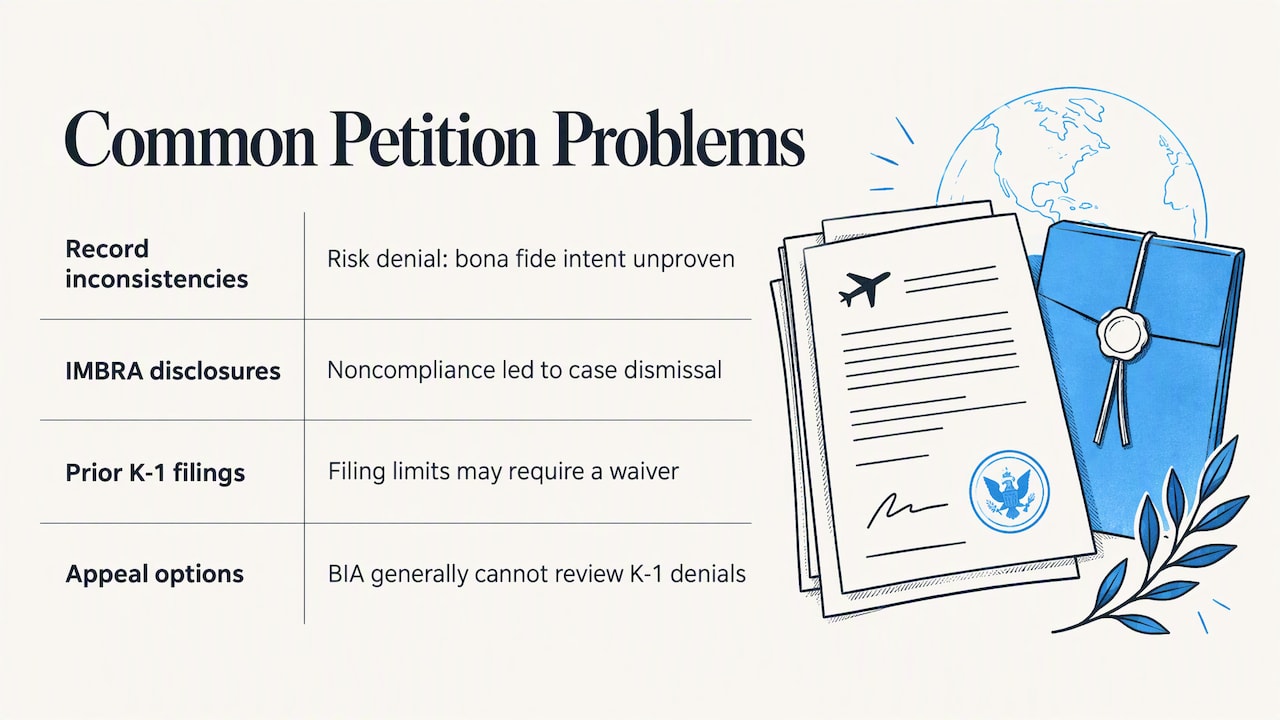
Inconsistencies in the record. In 2026 USCIS appeals decisions, omissions and contradictions in the record led to findings of minimal reliability, and from there to denial for failing to establish a bona fide intent to marry. Small mismatches matter more than people expect.
IMBRA disclosures. The International Marriage Broker Regulation Act requires petitioners to disclose certain criminal convictions and restraining orders. In a 2026 decision, USCIS dismissed a case where the petitioner failed to comply with these reporting requirements. If anything in your history might be reportable, talk to an attorney before filing.
Prior K-1 filings. IMBRA also requires USCIS to track repeated petitions. According to USCIS guidance, petitioners who reach the filing limits must request a waiver, and adjudicators have sole discretion over how much weight to give the evidence. A waiver request needs careful, well-organized support.
Limited appeal options. The Board of Immigration Appeals generally lacks jurisdiction to review denials of K-1 petitions. In practice, that means a strong first filing matters far more than a plan to fix problems later.
When to Hire a Fiancé Visa Lawyer
Many straightforward K-1 cases are filed without a lawyer. Even so, there are clear situations where hiring one pays for itself:
- Either of you has a prior marriage, especially with foreign divorce paperwork
- You have a criminal history, an arrest, or a protective order anywhere in your past
- Your fiancé(e) has a past immigration violation, a visa refusal or time spent unlawfully in the U.S.
- You have not met in person within two years and may need an exception
- You have filed K-1 petitions before
- There is a large age, language or cultural gap that an officer may probe
- You received a request for evidence or a denial
An attorney can give legal advice, prepare and file forms, and represent you before USCIS or an immigration court, according to Department of Justice guidance. That same guidance stresses that only licensed attorneys and accredited representatives recognized by the Department of Justice may legally provide these services. Notarios, visa consultants and “immigration assistants” cannot. Ask for a bar number and look it up with the state bar before you sign anything.
What a K-1 lawyer actually does
The work usually breaks down like this:
| Stage | What your attorney handles |
|---|---|
| Before filing | Eligibility review, prior marriages, criminal and immigration history, IMBRA questions |
| Petition | Completing Form I-129F, organizing relationship evidence, certified translations |
| USCIS review | Responding to requests for evidence |
| Consulate | Reviewing the DS-160 and documents, interview preparation |
| After arrival | Wedding timeline, adjustment of status, work permit and travel questions |
A Note on K-3 Visas
Some readers searching for a K-1 actually need a K-3, which is designed for a spouse of a U.S. citizen who is waiting abroad while a spousal petition is processed. If you are already married, the better path is often a direct spousal petition, and which route is faster depends on current processing. A short consultation can tell you which one fits your situation.
Our Perspective: Why Details Decide K-1 Cases
We have practiced immigration law in Central New York for nearly 30 years, and the pattern is consistent. The couples who run into trouble are rarely the ones with a weak relationship. They are the ones whose paperwork tells two slightly different stories: a date that does not match, a divorce that was never fully documented, a past incident nobody mentioned. We would much rather find those issues at our first meeting than have an officer find them a year into the process.
That is why every case here gets direct attention from the attorney, not a hand-off. You speak with Craig Nichols himself, in English or Spanish, and you hear plainly what the strengths and risks of your case are. For many couples, especially military families stationed at Fort Drum or families building a life in Syracuse, Utica or Binghamton, the K-1 is only the first milestone. We plan with you through the wedding, the green card and eventually citizenship, so each filing supports the next.
— Craig Nichols
Work With a Syracuse Fiancé Visa Lawyer
Nichols Law Offices, PLLC represents couples through every step of the K-1 process, from the first eligibility review to the green card after your wedding. We serve clients in Syracuse, Rome, Utica, Binghamton and the Fort Drum area, with bilingual support in English and Spanish. Our fees are not published, so ask about them when you contact us.
If you are ready to talk through your situation, visit our fiancé(e) visa and green card page to get started, or read about our broader family immigration services.
FAQ
Can a green card holder petition for a fiancé(e) visa?
No. The K-1 is available only to U.S. citizens. A permanent resident who wants to bring a foreign partner generally has to marry first and then file a spousal petition, so speak with an attorney about timing before making plans.
Does a K-1 visa give my fiancé(e) a green card?
No. It allows one entry, and you must marry within 90 days of arrival. After the wedding, your spouse applies for adjustment of status to become a lawful permanent resident, which is a separate filing.
Can we appeal if the K-1 petition is denied?
The Board of Immigration Appeals generally cannot review K-1 petition denials. Options depend on the reason for denial, and sometimes a new, better-documented petition is the practical route. An attorney can review the denial notice and tell you which path is realistic.
Do we have to meet in person before filing?
Yes, you must have met in person at least once in the two years before filing. Exceptions exist only for extreme hardship or strict, long-established cultural or social customs, and you must document them thoroughly.
Who is allowed to help me with a fiancé visa?
Only licensed attorneys and Department of Justice accredited representatives may lawfully give immigration advice. Ask for credentials and verify them before you hire anyone, including anyone who calls themselves a consultant or notario.
Sources
- Visas for Fiancé(e)s of U.S. Citizens, USCIS
- Nonimmigrant Visa for a Fiancé(e) (K-1), U.S. Department of State
- Learn about K-1 fiancé(e) visas, USA.gov
- Form I-129F instructions, USCIS
- Instruction package for K-1 visa applicants, Ho Chi Minh City
- USCIS appeals decision, June 25, 2026
- USCIS appeals decision, June 15, 2026
- USCIS IMBRA guidance memo
- Zhang v. Holder, U.S. Department of Justice
- Victim of Fraud?, Executive Office for Immigration Review
Recommended
- How to Get an Immigrant Visa (Green Card) in Syracuse, NY: Complete 2026 Guide
- Family Immigration in Syracuse, NY: Your Complete Guide to Sponsoring a Loved One for a Green Card
- Building Your Future Together: Family Immigration to Syracuse, NY
- Navigating Immigrant Visas: Your Path to the U.S. with Craig Nichols in Syracuse, NY