
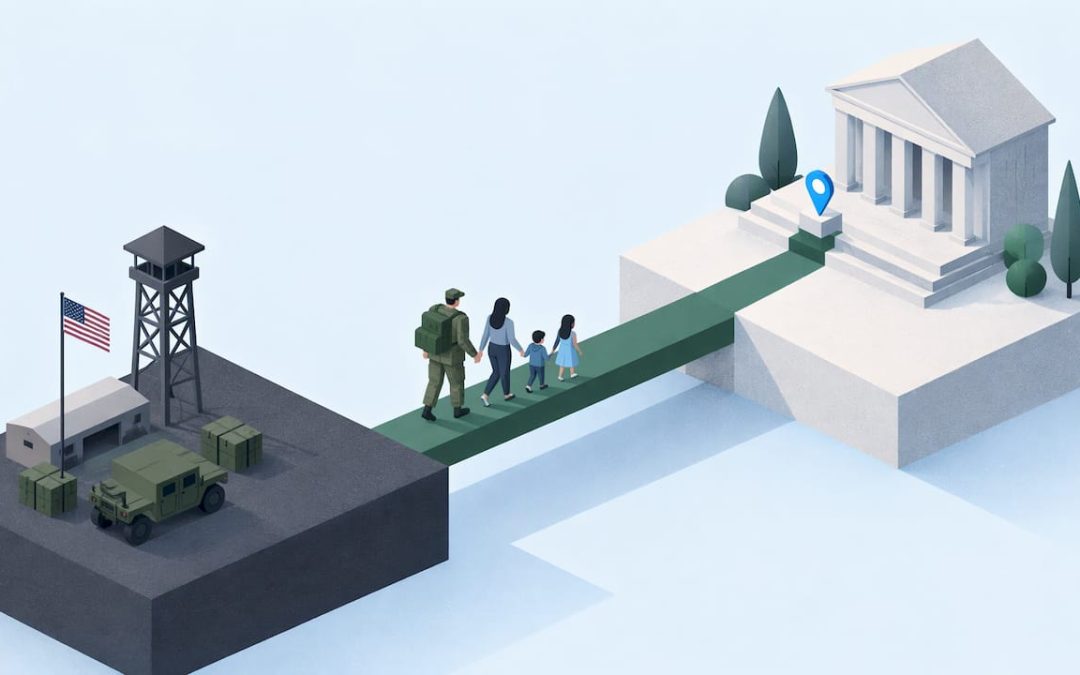
If you or your spouse serves at Fort Drum and a family member’s immigration status is unresolved, the best path is usually a private immigration attorney who knows military-specific options and works with you one on one. Base legal assistance is a valuable first stop, but it cannot represent you before USCIS or in immigration court. At Nichols Law Offices, PLLC, Craig Nichols brings nearly 30 years of experience in Central New York, speaks with you directly, and offers bilingual English and Spanish support for soldiers and families across Jefferson County and the region.
Key Takeaways
- Military service opens special options: Parole in Place for certain undocumented relatives, faster naturalization for service members, and fee-free military N-400 filing.
- The Fort Drum legal assistance office gives free advice, but its attorneys cannot represent you in civilian courts. Complex cases, prior denials or removal proceedings call for a private immigration attorney.
- Military service does not automatically give you or your relatives lawful status or citizenship. Each case still turns on its own facts and paperwork.
- Only a licensed attorney or a Department of Justice-accredited representative should handle your case, never a notario or consultant who promises guaranteed results.
- Gathering your military records, IDs and every immigration notice before a consultation makes the first meeting far more productive.
Table of Contents
- What military families near Fort Drum can do about immigration
- What the Fort Drum legal assistance office does, and where it stops
- Parole in Place: the option most Fort Drum families ask about
- Citizenship for service members and spouses
- Why military service is not a shortcut to status
- How to choose an immigration lawyer you can trust
- What to prepare before your first consultation
- Perspective
- How we can help your family
- FAQ
- Sources
What military families near Fort Drum can do about immigration
Military life changes the immigration picture in ways many families do not know about. ICE explains that case-by-case options, including parole in place and deferred action, may be available to current and former service members and their families, and that prosecutorial discretion may be available in removal proceedings.
In practical terms, the questions we hear from Fort Drum households fall into a few groups:
- A spouse, parent or child without status. A relative who entered without inspection may qualify for Parole in Place, which can open the door to a green card.
- A conditional green card. A spouse who received a two-year card must file to remove conditions. Applicants can file as early as 90 days before the card expires, and missing that window creates avoidable trouble.
- A fiancé(e) abroad. A K-1 petition can bring a future spouse to the United States for marriage, which matters when orders and deployments compress your timeline.
- A service member who is not yet a citizen. Military service shortens or removes several naturalization requirements.
- A past problem. An old arrest, a prior denial or an overstay can require a waiver or rehabilitation application before anything else moves.
If your concern is any of these, our military immigration lawyer page explains how we approach military cases, and our Fort Drum page is written for soldiers and families on the installation.
What the Fort Drum legal assistance office does, and where it stops
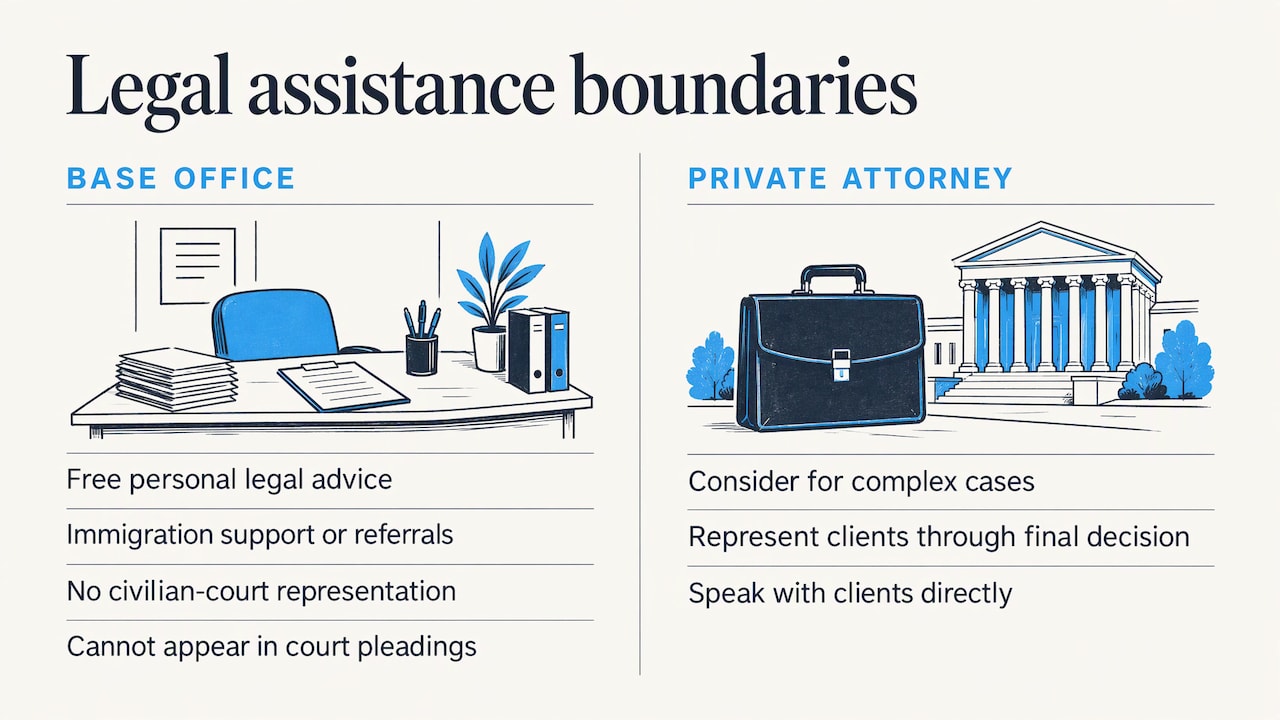
Your first call may well be to the installation. The Fort Drum Legal Assistance office is in Clark Hall, 10720 Mount Belvedere Boulevard, 2nd Floor, Room A2-68. The office lists 315-772-5261 as its appointment line and provides free advice and counseling on personal legal matters.
Military OneSource says legal assistance offices provide support or referrals on immigration, citizenship and naturalization, including fiancé visas, alien registration, reentry permits, passports, naturalization for a surviving spouse and citizenship for children born abroad to U.S. military parents.
The limits matter just as much. The same Fort Drum page states that its attorneys cannot represent clients in civilian courts or appear as attorneys of record in court pleadings. A Fort Riley immigration flyer for military families says it plainly: for complex cases or cases already in immigration court, consider a private immigration attorney, because base legal assistance cannot provide adequate counsel or representation. Navy legal services guidance draws the same line: cases involving criminal history, removal, unlawful presence, prior denials or urgent international travel should be reviewed by an experienced immigration attorney.
That is where we come in. We represent you from the first filing through the final decision, and we speak with you directly rather than passing you between staff.
Other Fort Drum and federal resources worth knowing
These are useful alongside your attorney, not in place of one:
- The Fort Drum Soldier & Family Readiness Division lists a Citizenship and Immigration Services support group, an International Spouse Support group and an English as a Second Language program. The Relocation Readiness Program is at the Family Resource Center, 11042 Mt. Belvedere Blvd., (315) 772-6566.
- The USCIS Military Help Line, 877-247-4645, serves service members, families and veterans Monday to Friday, 8 a.m. to 6 p.m. Eastern. It helps with N-400 status, notifying USCIS of a new duty station and expedited processing of military N-400 and N-600 applications.
- Military OneSource, at 800-342-9647, offers real-time interpretation and free translation of legal documents such as marriage licenses.
Parole in Place: the option most Fort Drum families ask about
Parole in Place (PIP) is a discretionary grant that lets certain relatives who entered the country without being admitted stay in the United States temporarily. For a spouse of a soldier, that can matter enormously, because a lawful entry on record is often the missing piece for adjusting to permanent residence without leaving the country.
The USCIS Adjudicators Field Manual describes who can ask and what the request needs. According to Chapter 21 of the manual:
- Eligible spouses, parents, sons and daughters of active-duty, Selected Reserve or qualifying former service members may request it.
- The request uses Form I-131 with no filing fee, proof of the family relationship, evidence of military service such as the service member’s military ID, two passport photos and any other favorable factors.
- PIP ordinarily weighs heavily in favor of a grant for these families, and it is authorized in one-year increments.
- It is not available to people who were admitted and then overstayed. Those relatives may be considered for deferred action, decided case by case and, if granted, authorized in two-year increments.
The distinction between “entered without inspection” and “admitted and overstayed” decides which route you are on, and it is not always obvious from a family’s memory of how someone arrived. We sort that out at the start. Our dedicated page on Parole in Place for military families walks through the process, and the Parole in Place page shows how we help secure a green card afterward.
Worked example
Imagine a sergeant stationed at Fort Drum whose wife came to the United States years ago without inspection. She cannot simply adjust status today. With an approved PIP request supported by the sergeant’s military ID, the marriage certificate and photos, she may then be able to apply for a green card as the spouse of a U.S. citizen. If the sergeant is a green card holder rather than a citizen, the analysis changes, and the wait and eligibility rules differ. That is exactly the kind of fork where a personal review pays for itself.
Citizenship for service members and spouses
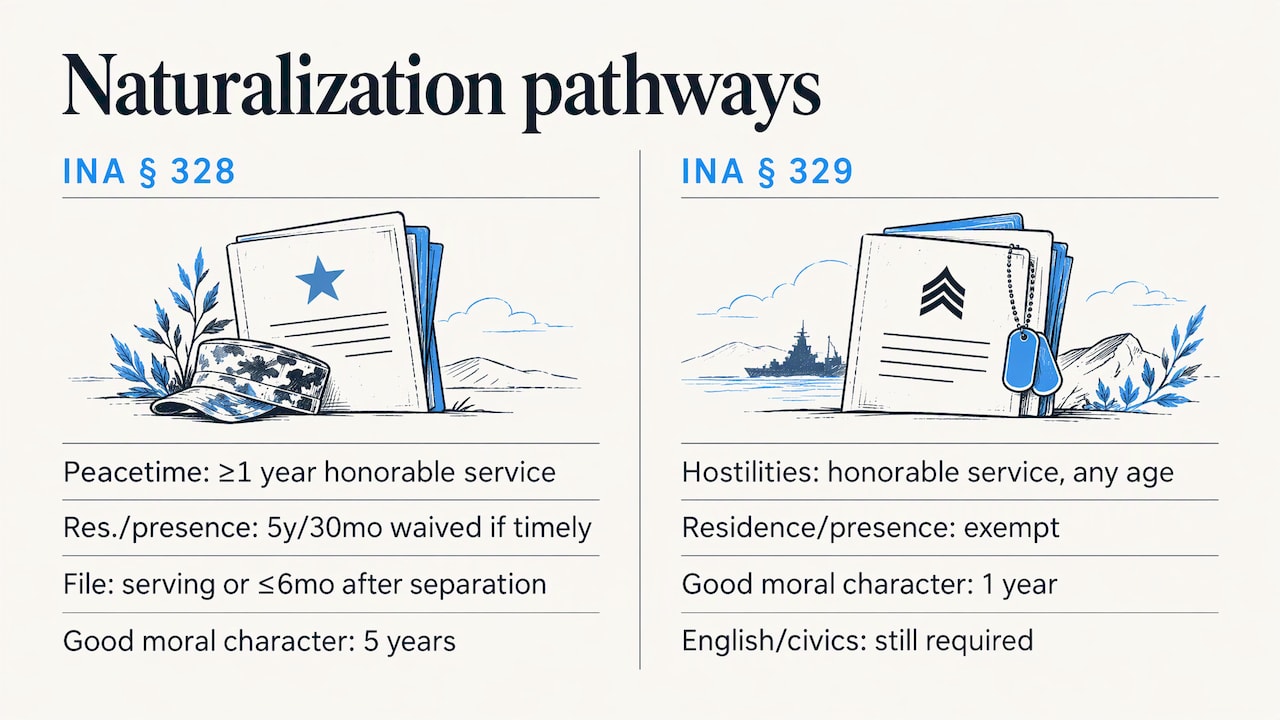
Military service speeds the path to citizenship. A Congressional Research Service report explains that under INA § 328, peacetime service members may naturalize after at least one year of honorable service. They are exempt from the five-year residence and 30-month physical-presence requirements if they file while serving or within six months of separation, and must show five years of good moral character. Military applicants under §§ 328 and 329 do not pay the N-400 filing fee, and current service members submit Form N-426 to certify service.
Service during a designated period of hostilities falls under INA § 329. The N-400 instructions say those applicants may naturalize at any age upon establishing honorable service, need only one year of good moral character, are exempt from continuous residence and physical presence, and must still meet the English and civics requirements.
For families on the move, the same CRS report notes that USCIS allows servicemembers serving overseas and their qualifying relatives to complete interviews and oath ceremonies over video. Military OneSource adds that eligible permanent-resident spouses accompanying a service member abroad may be able to naturalize without traveling to the United States under 8 U.S.C. § 1430(e), while spouses who do not meet § 319(a) may proceed under § 319(b) but must interview and take the oath in the United States.
These rules interact with orders, deployments and discharge dates, which is why timing errors are the most common problem. A filing made a week too late can mean a different set of requirements. Our naturalization page outlines how we handle citizenship cases for service members and their relatives.
Why military service is not a shortcut to status
Many families assume that wearing the uniform settles the question. It does not. The Navy’s legal services guidance states that military service can create special naturalization procedures and may support certain options, but it does not automatically grant lawful status or citizenship to the member or relatives. Family-based cases still involve petitions, priority dates, adjustment of status or consular processing, financial sponsorship, medical exams, admissibility review and security checks.
If any relative has a criminal record, a prior removal order or an old denial, the case needs a plan before anything is filed. Where a past issue stands in the way, we prepare rehabilitation applications and waivers. Where removal proceedings have begun, we defend them, and our deportation defense page explains what to do first.
How to choose an immigration lawyer you can trust
The People Also Ask box on this topic repeatedly asks how to know whether a lawyer is good. These are the checks that matter:
- Confirm the license. Representation should come from a licensed attorney, or a Department of Justice-accredited representative working through a recognized organization, as the Navy legal services guidance explains. Notarios and consultants who promise guaranteed results are a warning sign.
- Ask who actually handles your file. Immigration cases involve long timelines. You should know who answers your questions and who signs your filings.
- Look for military-case experience. PIP, N-426, military deferred action and discharge documents are specialized. Ask how many such cases the attorney has handled.
- Make sure you can communicate. If a spouse is more comfortable in Spanish, the attorney’s office should be too.
- Check local familiarity. Knowing the regional USCIS and court procedures saves time.
At our firm, you work with Craig Nichols himself, with nearly 30 years of experience behind your case, and with bilingual support in English and Spanish. Our office is at 333 Butternut Dr, Ste 106, in Syracuse, and we serve families in Jefferson County, Watertown, Rome, Utica and Binghamton as well.
What to prepare before your first consultation
A focused first meeting lets an attorney give you real answers instead of a list of questions. Bring what you have, and say plainly what you do not have.
- Service member documents: military ID, orders, proof of service dates, and a DD Form 214 if separated.
- Identity and relationship documents: passports, birth certificates, marriage certificate, divorce decrees if any, and proof of your relationship such as joint leases or photos.
- Immigration papers: every notice you received, receipts, approvals, denials, green cards, visas and I-94 records.
- A timeline: how and when each person entered the United States, where each has lived, and any trips abroad.
- Any police or court records: even old or dismissed matters, since they affect strategy.
- Upcoming deadlines: card expiration dates, court dates, PCS or deployment dates.
If a document is in another language, bring it anyway. Military OneSource offers free translation of many legal documents, and we can tell you which ones need a certified translation for the filing.
Perspective
Over nearly three decades of practice in Central New York, I have learned that military families carry two kinds of pressure at once: the demands of service and the uncertainty of a relative’s status. A soldier cannot leave a post to sit in a waiting room, and a spouse should not have to guess which form comes first.
That is why we do our work the way we do. You talk with me directly. We explain the options in plain language, in English or Spanish, and we build the case around the dates that govern your life: orders, discharge, card expirations. Free base legal assistance is a good starting point, and when your case calls for someone to stand beside you before USCIS or an immigration judge, we are here to do that.
Every family I meet is trying to build a future in this country they have served or sacrificed for. Our job is to make the pathway clear, and to walk it with you.
Craig Nichols
How we can help your family
Nichols Law Offices, PLLC handles the full range of cases military families bring us: Parole in Place, green cards and adjustment of status, conditional green card removals, K-1 fiancé(e) visas, naturalization, waivers, work authorization and deportation defense. Our green card services cover adjustment of status and fiancé visas, and our family immigration page covers sponsoring a spouse, parent or child. If you hold a two-year card, our conditional green card page explains how to remove the conditions.
If your family is stationed at or near Fort Drum, contact our office through our website to talk through your situation with Craig Nichols.
FAQ
Can I get a free lawyer in the military for an immigration problem?
Yes, for advice. Installation legal assistance offices provide free counsel and referrals on immigration, citizenship and naturalization, and may refer clients based on financial need to the American Bar Association’s Military Pro Bono Project. However, the Fort Drum office states that its attorneys cannot represent clients in civilian courts, so a case that needs filings handled or a court appearance requires a private attorney.
Is it possible to get a free immigration lawyer in New York?
Sometimes. New York’s Office for New Americans funds legal counsel for immigrants statewide, and the New Americans Hotline, 1-800-566-7636, is the access point, open 9 a.m. to 8 p.m. Monday through Friday in more than 200 languages. Capacity varies, so families who want a dedicated attorney with military-case experience often retain one directly.
Does my service guarantee my spouse a green card?
No. Service can unlock options such as Parole in Place or military deferred action, but it does not automatically grant lawful status. Eligibility depends on how your relative entered, your own status, and any past issues. A review of your documents is the only reliable way to know which route applies.
Do military applicants pay the N-400 filing fee?
No. Under INA §§ 328 and 329, military applicants do not pay the N-400 filing fee. Parole in Place requests also use a fee-free Form I-131. Other forms in a family case may carry fees, so confirm the full list for your situation.
How do I know an immigration lawyer is legitimate?
Verify that the person is a licensed attorney or a Department of Justice-accredited representative. Be wary of anyone who guarantees results or asks you to sign blank forms. You should understand what is being filed on your behalf and who is responsible for it.
Sources
- Military Citizenship & Immigration Services, Military OneSource
- Services for Current and Former Immigrant Military Members, ICE
- Soldier & Family Readiness Division, Fort Drum
- Immigration Options for Military Families flyer, U.S. Army
- Fort Drum Legal Assistance, MilitaryINSTALLATIONS
- Military Legal Assistance & Paperwork, Military OneSource
- Military Help Line, USCIS
- Overseas and Specialized Areas: Immigration, Navy JAG
- Adjudicators Field Manual, Chapter 21, USCIS
- Naturalization for Military Service Members, Congressional Research Service R48163
- Form N-400 Instructions for Application for Naturalization
- Governor Hochul Announces $8.7 Million in New Grants, New York State
Recommended
- Military Immigration Lawyer: Help for Service Members and Their Families
- Immigration Lawyer in Syracuse, NY: Trusted Legal Help for Families, Military, and Dreamers
- Fort Drum / Military Personnel
- Parole in Place (PIP) for Military Families: How Syracuse Immigration Lawyers Help Secure Green Cards in 2026